

Best CRM Software for Marketing Agencies in 2026
- October 12, 2026
- 0
Agencies carry two pipelines at once. One holds the proposals and retainers keeping your own doors open, and the other holds the leads your campaigns generate for clients.

Agencies carry two pipelines at once. One holds the proposals and retainers keeping your own doors open, and the other holds the leads your campaigns generate for clients.
Agencies carry two pipelines at once. One holds the proposals and retainers keeping your own doors open, and the other holds the leads your campaigns generate for clients. The best CRM software for marketing agencies covers whichever pipeline you actually run, and a few cover both.
Pipedrive suits agencies focused on winning their own new business. HubSpot connects inbound marketing with sales, and HighLevel runs lead-generation workflows across separate client accounts. Seven more tools below fit narrower situations, from Google Workspace teams to boutique shops.
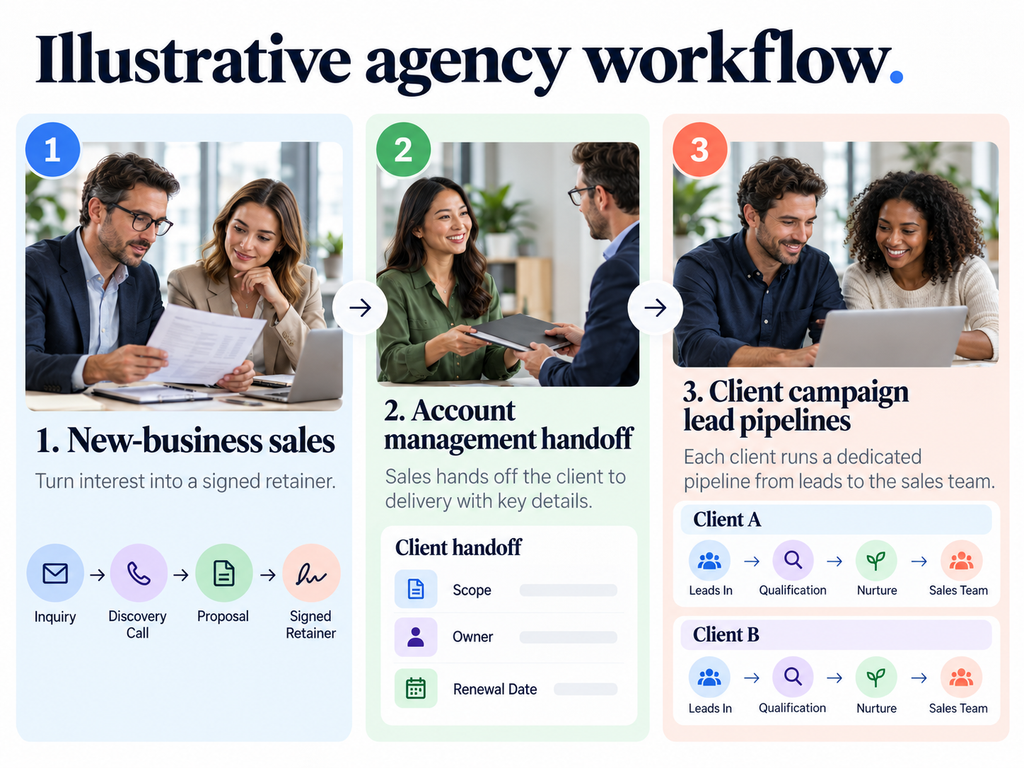
A marketing agency sales pipeline usually moves through inquiry, discovery, proposal, negotiation, and signed agreement. Every open deal needs an owner and a next action.
Keep a proposal awaiting feedback besides its follow-up date. A deal value with no next step gives you a number and no plan.
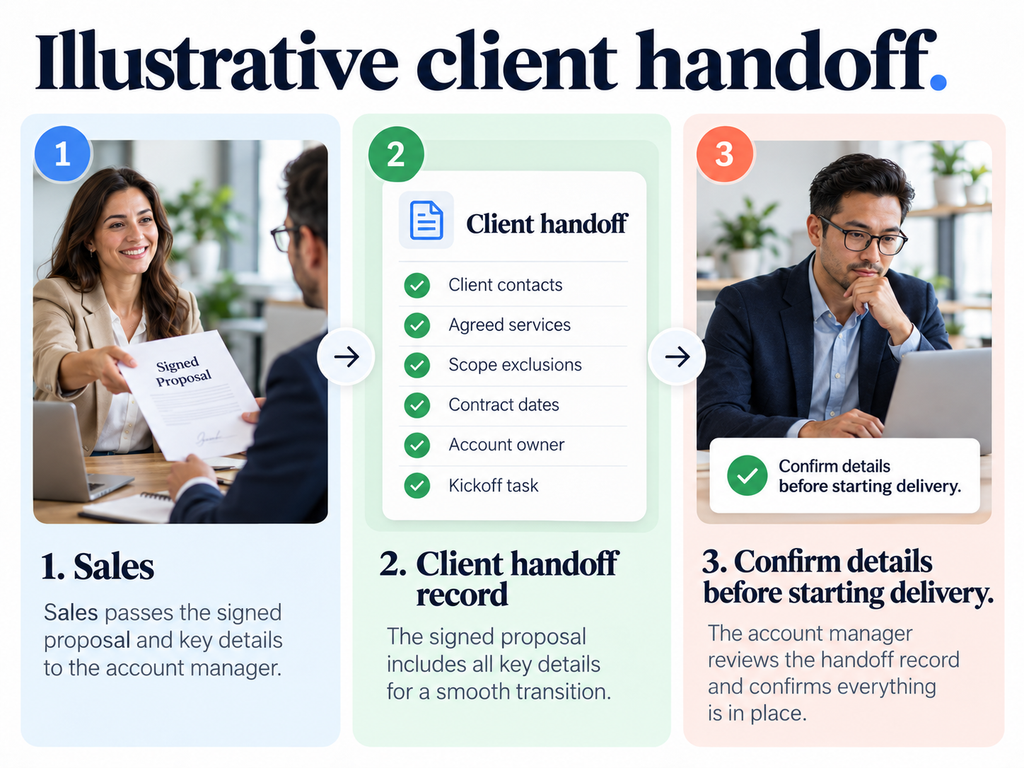
Record decisionmakers, services purchased, account ownership, and renewal dates. With those in place, an account manager can see what sales promised without digging through separate inboxes.
Campaign production often stays on a project management platform, so plan the handoff between the two. Our roundup of project management tools for creative agencies covers delivery tools worth pairing with a CRM, and our guide to agency CRM types sorts options by project, retainer, and mixed revenue models.
Agencies running lead systems for clients need agency lead management software with separate accounts and access controls. Labels on one shared contact list can look tidy while still mixing client data together.
If you only track your own prospects, our small-business CRM selection guide walks through CRM types and features by workflow.
This shortlist shows where each product fits. The numbers keep the list tidy and carry no ranking, since each tool wins in a different kind of agency.
| CRM | Evaluation focus | Entry point (USD) |
| HubSpot | Inbound marketing and sales alignment | Free CRM, or $90 per seat for Sales Hub Professional |
| HighLevel | Separate client lead-generation accounts | $97 per month with three sub-accounts |
| Pipedrive | Agency new-business pipelines | $14 per seat |
| Zoho CRM | Customized processes and automation | $14 per user |
| monday CRM | Sales coordination and delivery handoffs | $12 per seat |
| Insightly | CRM and project tracking | $29 per user |
| Copper | Google Workspace integration | $23-29 per seat |
| Freshsales | Sales communication and follow-ups | $9 per user |
| Capsule | Smaller-agency relationship management | Free for two users |
| Salesforce | Complex sales processes and governance | $25 per user |
Prices come from the linked vendor pages, checked on 13 October 2026. All figures are USD with annual billing unless noted, and the plan holding the features you need often costs more than the entry point.
HubSpot’s free CRM covers up to two users and 1,000 contacts, and its free marketing tools include a form builder. An inbound agency can start capturing leads on day one and decide later what to buy.
Marketing Hub is the upgrade for campaign management and lead nurturing, with Professional listed from $890 monthly including three seats. Sales Hub Professional costs $90 per seat monthly on annual billing and carries a required $1,500 onboarding fee, per HubSpot’s Sales Hub pricing guide (updated 9 September 2026). Marketing Hub carries its own pricing on top.
Trace one website inquiry through qualification and into a proposal, then ask whether the next person can read the full history. Agencies comparing HubSpot with a multi-client platform will find more detail in our HighLevel vs HubSpot comparison for agencies.
HighLevel describes its Unlimited plan as built for growing agencies, and its feature list covers sales pipelines, forms, surveys, and workflow automations.
Starter costs $97 monthly and includes three sub-accounts. Unlimited costs $297 with unlimited sub-accounts, and Agency Pro costs $497 and adds SaaS Mode, which lets you rebill software to clients with a markup.
Sub-account limits shape this decision more than your headcount does. Usage charges also sit on top of the plan. HighLevel’s pricing and billing guide lists email at $0.675 per 1,000 messages, AI Employee plans at $50 or $97 monthly per enabled location, and phone pricing matched to Twilio rates. Our explainer on usage-based SaaS pricing shows how to budget for metered costs like these, and our list of white-label SaaS tools for agencies covers resale options beyond HighLevel.
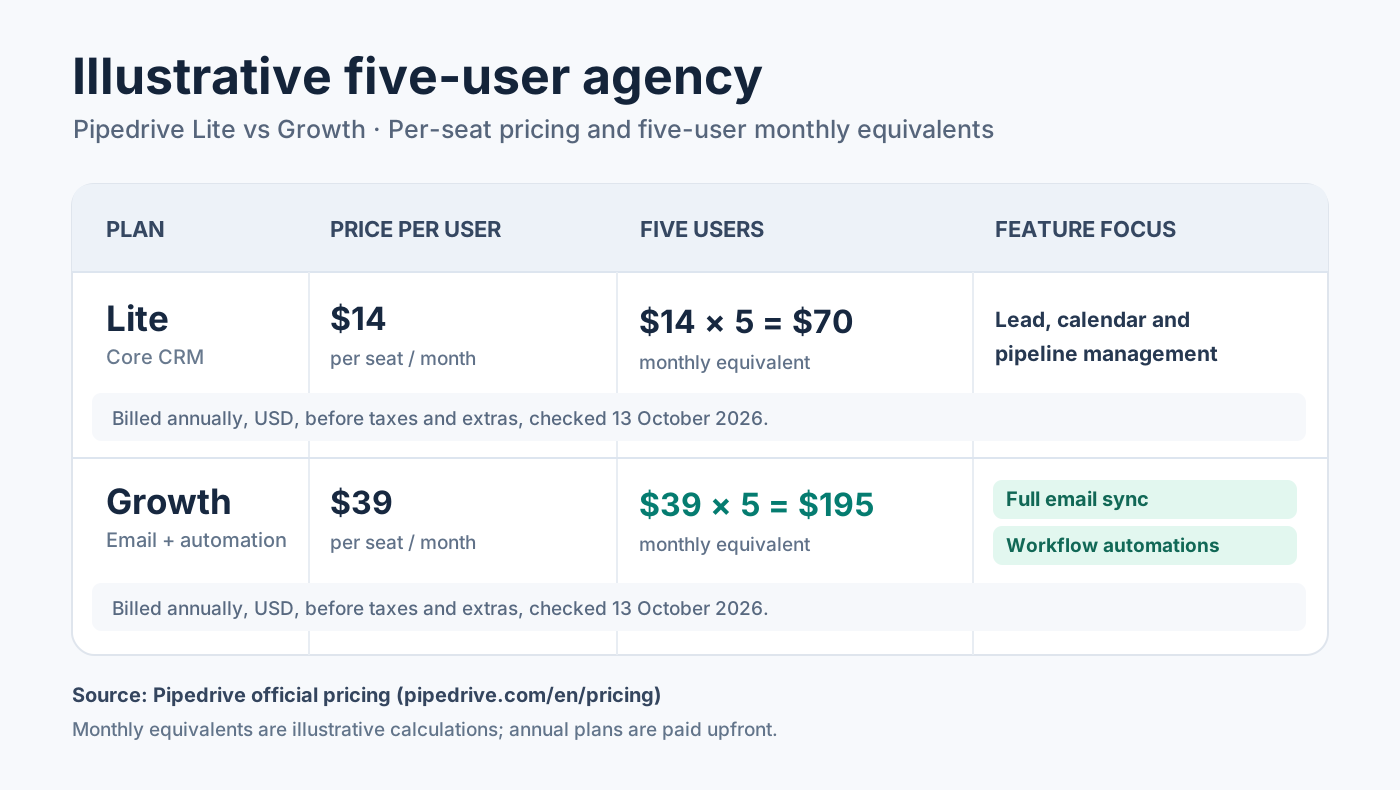
Pipedrive keeps its attention on the sale itself. Lite covers lead, calendar, and pipeline management at $14 per seat monthly with annual billing. Growth costs $39 and adds full email sync with tracking, automations, and nurturing sequences.
A five-user agency needing Growth pays $195 monthly equivalent, which comes to $2,340 annually before taxes and extras. The same team on Lite pays $70.
Projects and Campaigns are sold as add-ons, listed from $16 and $13.33 respectively without a stated billing basis, so price the full setup before comparing totals. Teams prospecting heavily on LinkedIn can read our Breakcold vs Pipedrive comparison for an outbound-focused alternative.
Zoho CRM gives an agency plenty of room to shape the system around its own services. Standard starts at $14 per user monthly with annual billing, per Zeeg’s 2026 pricing breakdown (updated 28 September 2026). Zoho’s own page displays local currency by default, so switch its currency selector to USD to confirm.
Zoho’s feature availability table allows five sales pipelines on Standard, which suits an agency selling monthly SEO retainers and one-off website projects through separate stages. Blueprint, Zoho’s step-by-step process tool, begins at Professional according to the Blueprint FAQ. Agencies shopping for a CRM with workflow automation should price Professional from the start.
Flexibility comes with setup work, so name the person who will maintain fields, workflows, and reports before building any. Our Zoho CRM vs Freshsales comparison helps weigh customization against a shorter onboarding curve.
monday CRM places leads, communication, and next actions on boards, a familiar layout for teams already living in visual workspaces. Basic starts at $12 per seat monthly on annual billing, Standard costs $17 and includes 250 custom automations monthly, and Pro costs $28 with 25,000 automations and email sequences. Plans start from three users.
During a trial, push a won deal through the handoff. Can the account manager find the agreed scope, contact history, and next task without asking sales to explain it again?
monday sells work management as a separate product, so confirm what the CRM plan includes before counting on it to run campaign delivery.
Insightly’s pitch is the handoff, with sales records and project tracking in one subscription. According to its plans page, Plus costs $29 per user monthly on annual billing and includes lead and contact management, project management, and advanced reports. Professional costs $49 and adds lead assignment and routing, workflow automation, and AI Copilot.
Integrations cost extra. AppConnect is sold separately, starting at $249 monthly for 25,000 tasks, and the page lists a $3,000 technical setup fee. Follow one branding engagement from proposal through kickoff and delivery to see whether responsibilities stay clear.
If your account managers already live in Gmail, Copper meets them there. Its Google Workspace integration adds contacts from the inbox through a Chrome extension, syncs documents to contact records after you send them, and surfaces customer details from Google Calendar.
Basic costs $23 per seat monthly with annual billing and includes task automation, pipelines, project management, and contact enrichment, with a 2,500 contact cap. Professional costs $59, raises the cap to 15,000, and adds workflow automation, bulk email, reporting, and integrations. Business costs $99 with unlimited contacts.
Agencies with long client history should watch the Basic cap. Test with an ordinary client email and proposal document, and confirm which Workspace features your chosen plan includes.
Freshsales leans toward the phone, the inbox, and the follow-up cadence. Growth costs $9 per user monthly on annual billing and lists a Kanban view, chat, email, and phone, custom fields, and basic workflows. Pro costs $39 and adds contact scoring, deal insights, territory management, and sales sequences.
Freshworks publishes Freshsales and Freshsales Suite pricing on separate pages. The Suite page includes 500 marketing contacts in Growth and sells more from $100 per 5,000 contacts monthly, so match the package to your plan. Calling and add-on costs belong in the budget too, since a low seat price rarely reflects the whole outreach workflow.
Capsule stays small on purpose, which suits a boutique agency needing a reliable client record. The free plan supports two users and 250 contacts. Starter raises the limit to 30,000 contacts and adds a shared mailbox and basic reporting.
Growth reaches 60,000 contacts and adds workflow automations, multiple pipelines, project boards, email sync, and team and access controls. Capsule’s page bills paid plans per user annually and saves up to 18%, though it shows no dollar figures per plan, so check the signup flow for current rates.
Test it on three tasks, finding a client’s history, scheduling a follow-up, and tracking a renewal. For other zero-cost options, our roundup of eight free CRMs is a good starting point, and our affordable CRM guide covers low-cost paid tiers.
Salesforce rewards agencies with process complexity and an admin to match. Starter Suite costs $25 per user monthly, billed monthly or annually. Pro Suite costs $100 with annual billing, and the higher Core, Advanced, and Max editions run $195, $395, and $550 respectively on annual terms.
Evaluate it against specific requirements such as approval steps or reporting across several sales teams, and budget for configuration, training, and ongoing administration. An agency with one straightforward pipeline may find the commitment larger than the workflow needs. Our Salesforce pricing breakdown and HubSpot vs Salesforce comparison go deeper on cost and fit.
A CRM for client management earns its keep at the moment a deal closes. Configure it to pass agreed services, account owner, contract dates, and the next action to the delivery team, and keep signed documents reachable from the client record.
In an illustrative SEO retainer workflow, “won” should trigger a kickoff task and a scope confirmation. Recording the sale alone leaves onboarding half finished. During a trial, check which steps run automatically and which still need manual work or a connected project tool.
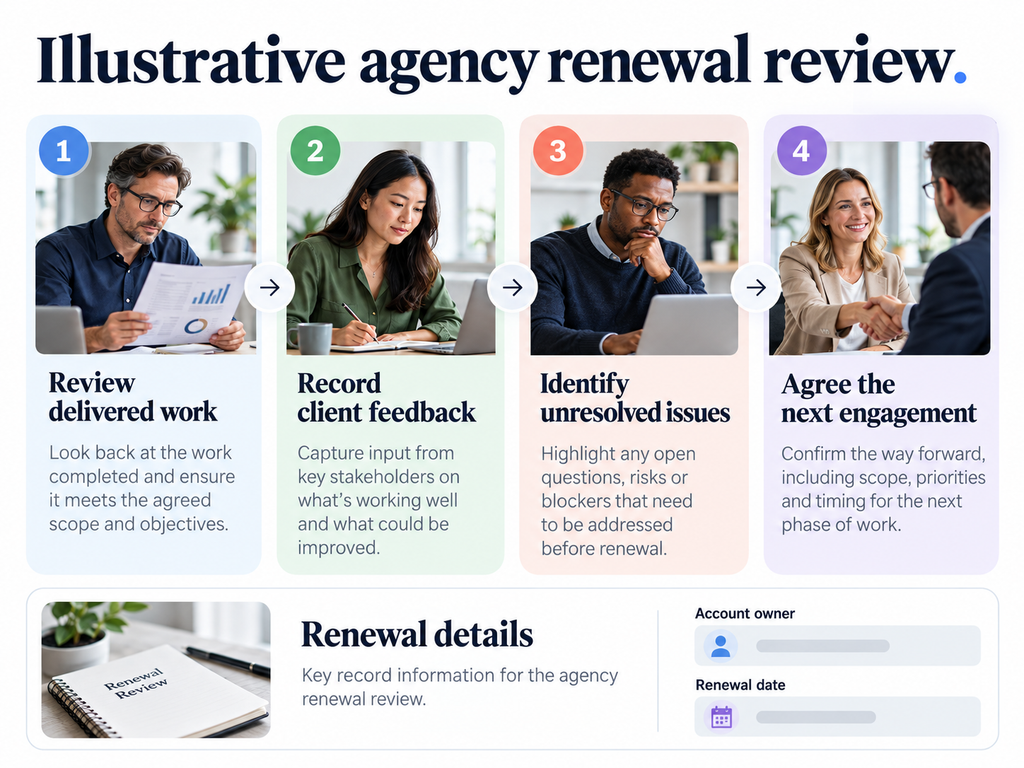
Record renewal dates and assign someone to review each account ahead of time. Useful relationship notes cover changing priorities, open concerns, and possible new services.
A renewal reminder opens a conversation. Satisfaction still comes from delivery evidence and direct client feedback, which account managers need to gather themselves.
Compare equivalent capabilities instead of entry-level subscriptions. Several features agencies want sit one tier above the headline price.
Then add seats, billing commitments, onboarding fees such as HubSpot’s $1,500, integration costs such as AppConnect, and usage charges such as HighLevel’s phone and email. Our guide to SaaS pricing models explains how per-seat, flat-rate, and usage-based plans change the math as you grow.
Pricing checked against vendor sources on 13 October 2026. Confirm regional prices, taxes, and current offers before purchasing.
An integration listing is a starting point. Verify what transfers, which direction it moves, and whether your subscription includes it. Our explainer on SaaS integrations compares native connectors, Zapier, Make, and direct APIs, and our Zapier vs Make comparison covers the budget side.
During a trial, connect a sample inquiry, proposal, and client record to your existing tools, then check ownership, duplicate handling, and permissions. Use fictional or anonymized data until you understand the access controls.
Contact caps arrive early for agencies with long histories. HubSpot’s free CRM stops at 1,000 contacts, Capsule’s free plan at 250, and Copper Basic at 2,500. Seat minimums matter for small teams, and monday CRM starts at three users. HighLevel limits sub-accounts, so a growing client roster pushes you from Starter to Unlimited. Salesforce leaves the most room to grow and asks for admin time in return.
Shortlist by the problem you need to solve, then involve the people who will maintain the system.
| Agency requirement | Start by evaluating |
| New-business pitches and follow-ups | Pipedrive or Freshsales |
| Connected inbound marketing and sales | HubSpot |
| Separate client lead-generation accounts | HighLevel |
| Relationship-to-project handoffs | Insightly or monday CRM |
| Google Workspace integration | Copper |
| Smaller-team contact management | Capsule |
| Customized processes | Zoho CRM or Salesforce |
Size is a key indicator in deciding the Best CRM software for your marketing agency. Solo operators and boutique agencies usually do well with Capsule, Freshsales Growth, Pipedrive Lite, or HubSpot’s free CRM. Growing agencies with several account managers tend to need the automation tiers of Pipedrive, Zoho CRM, Insightly, or Copper. Multi-team agencies can justify Salesforce, HubSpot’s paid hubs, or HighLevel Unlimited for a large client roster.
For a wider view, see our guide to choosing CRM software for growing teams and the agency CRM types guide.