

What Is Usage Based Pricing? And Is It Good for SaaS Buyers?
- July 13, 2026
- 0
Most enterprise software buyers spent the 2010s negotiating seat counts. The model was simple: your team has 50 people who need access, you pay for 50 seats, and

Most enterprise software buyers spent the 2010s negotiating seat counts. The model was simple: your team has 50 people who need access, you pay for 50 seats, and

Most enterprise software buyers spent the 2010s negotiating seat counts. The model was simple: your team has 50 people who need access, you pay for 50 seats, and your costs are predictable. That model is now the exception rather than the rule in significant portions of the SaaS market.
Usage based pricing (UBP) has become the dominant direction in SaaS economics, driven by two converging forces: enterprise procurement teams grew tired of paying for software seats that were underused, and AI fundamentally changed vendor cost structures in ways that flat subscription pricing cannot absorb. According to Stripe’s usage-based pricing analysis, 74% of software suppliers had adopted usage based models by 2026, with 56% expecting usage-based revenue to grow further by 2027.
For buyers, this shift is a mixed development. Usage based pricing can genuinely align costs with value, reducing waste from shelfware and removing the barrier to adoption for tools that justify their cost through actual use. It also introduces a different kind of risk: the unexpected bill, the budget overrun, the AI feature that burned through an overage budget in a single week.
This guide explains how usage based pricing actually works, what forms it takes across the SaaS market, where the real risks lie for buyers, and how to evaluate tools with consumption based components before you commit to them.
Usage based pricing means your software costs vary based on how much you actually use a product rather than being tied to a fixed number of licensed seats. Instead of paying $X per user per month regardless of activity, you pay based on a measurable unit of consumption.
The consumption unit varies significantly by product type. Email marketing platforms charge per number of contacts or emails sent. API products charge per API call. AI tools charge per token, per query, or per action completed. Analytics platforms charge per event processed. Customer support tools are beginning to charge per resolved ticket.
This is not a new concept. Infrastructure providers like AWS built their entire business on consumption pricing from the beginning. What is new in 2026 is how broadly UBP has spread beyond infrastructure into application layer SaaS that previously operated on subscription models, and how AI has created strong pressure for that shift.
Customers pay only for what they use, with no minimum commitment or base fee. Billing is entirely tied to consumption. This is the model OpenAI and AWS EC2 use for their core offerings. It provides maximum flexibility but also maximum cost unpredictability, which is why many enterprise buyers resist pure PAYG arrangements and push for committed use agreements with discounts.
Customers pay a fixed monthly or annual base fee that includes a usage quota. Consumption beyond that quota is billed at a per unit overage rate. This is the most common model in SaaS in 2026. HubSpot’s contact based pricing, for example, includes a set number of contacts per tier with per contact charges above that threshold. It provides revenue predictability for vendors while retaining some flexibility for buyers.
Customers purchase a block of credits upfront and draw down against those credits as they use the product. AI tools have made this model prevalent. OpenAI, Anthropic, and Midjourney all use credit based systems. Buyers get budget predictability because they cannot overspend beyond purchased credits without buying more. Vendors get revenue certainty upfront. The tradeoff is that unused credits may expire, creating the same shelfware problem that usage based pricing was supposed to solve.
Customers pay only when a specific outcome is achieved, such as a customer service ticket being resolved or a sales meeting being booked. This is the most nascent model and represents the direction the most ambitious vendors are pushing toward. Intercom’s Fin AI charges $0.99 per resolved interaction. Zendesk has introduced outcome based tiers. Salesforce’s Agentforce charges approximately $2 per agent conversation. The alignment between cost and delivered value is strongest in this model, but it also requires clear definition of what constitutes a successful outcome and robust tracking to verify it.
Understanding why vendors are making this shift helps buyers negotiate and evaluate more effectively.
The most direct driver is AI. When a software vendor integrates large language model features, their cost of goods sold changes fundamentally. Running a traditional SaaS feature costs roughly the same amount per user regardless of how much they use it. Running an LLM inference request costs the vendor real money each time it happens, at a rate that varies significantly based on model size and input complexity.
This creates a structural problem with flat subscription pricing: a power user who generates 10,000 AI assisted outputs a month costs the vendor far more than a light user who generates 100, but both pay the same subscription fee. McKinsey’s 2026 Software Pricing Report found that 62% of SaaS platforms introduced AI premium tiers as a response, with buyers budgeting 25 to 35% higher when adding AI functionality to existing stacks.
The second driver is buyer behavior data. Zylo’s research consistently finds that organizations waste significant SaaS budget on seats that are minimally or never used. Usage based pricing, in theory, eliminates this waste by aligning the cost with actual activity. Enterprise procurement teams have been pushing for this alignment, and vendors have responded.
The benefits of usage based pricing are genuine: flexibility, value alignment, lower barriers to initial adoption, and elimination of shelfware. The risks are equally real and deserve specific attention, particularly as AI features push consumption models into product categories where buyers have no experience managing variable costs.
According to Zylo’s 2026 SaaS Management Index, 78% of IT leaders surveyed reported experiencing unexpected charges tied to AI features or consumption-based pricing in the past 12 months. That is not a small minority having occasional surprises. It reflects a structural issue: AI features generate consumption in ways that are hard to predict before deployment, and most buyers have no experience modeling variable AI costs at scale.
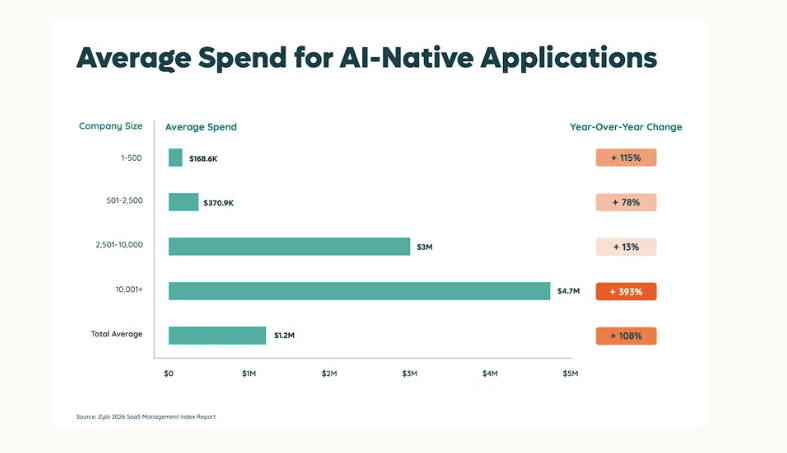
Spending on AI native applications surged 108% year over year in the 2026 index, and by 393% among organizations with more than 10,000 employees. Even as token prices fell 80% year over year, total AI spending grew 320% because consumption volumes increased far faster than unit prices declined.
Finance teams rely on predictable software costs for accurate budgeting. Consumption based pricing introduces variability that annual budgeting cycles struggle to accommodate. When 81% of SaaS spend is controlled by business units rather than central IT, according to Zylo’s data, the combination of decentralized purchasing and unpredictable pricing creates serious visibility problems.
A business unit that adopts a tool with usage based AI features may generate costs that surface to finance only at invoice time. By then, the budget variance is a problem to explain rather than a cost to control.
Many usage based pricing models are not transparent enough at the point of purchase. Buyers often do not know their usage unit clearly, do not know what typical consumption looks like for organizations similar to theirs, and are not given tools to forecast their bills before deployment. Retrospective invoice surprises are a real phenomenon and a documented churn driver.
Credit based models can recreate the shelfware problem they claim to solve. If a buyer purchases a credit pack that includes more credits than they actually use, and those credits expire on a rolling basis, the net economics may be worse than a subscription with a slightly higher per unit cost. Organizations should model their expected usage before selecting a pricing tier and ask vendors specifically about credit rollover and expiration policies.
| Factor | Traditional Subscription (Seat Based) | Usage Based Pricing |
| Cost Predictability | High. Fixed monthly or annual cost | Low to medium. Varies with consumption |
| Alignment with Value | Low. Pay the same regardless of usage | High. Cost tracks actual value received |
| Budget Planning | Simple. Headcount times seat price | Complex. Requires usage forecasting |
| Risk of Shelfware | High. Unused seats still cost money | Low (pay as you go) or medium (credit plans) |
| Risk of Bill Shock | Low. Invoice is predictable | High for AI features and unexpected spikes |
| Vendor Lock In Risk | Medium | Medium. Switching mid term is complex |
| Negotiating Leverage | High. Seat count is a clear leverage point | Medium. Requires usage data to negotiate |
| Best For | Standard business tools, consistent team wide usage | API products, AI features, variable workloads |
| 2026 Trend Direction | Declining as primary model | Accelerating, especially for AI native tools |
The clearest way to understand how usage based models work in practice is through specific vendor examples.
Buyers who approach usage based pricing tools with the right questions at the evaluation stage avoid most of the problems that lead to budget surprises.
Our billing platform comparison covers platforms that help SaaS vendors implement usage based billing, which gives buyers useful context for understanding how their vendors are managing the metering and billing infrastructure behind these models. Understanding the operational complexity vendors face in implementing UBP explains why some do it better than others.
The honest answer is: it depends on the product category, your consumption patterns, and how well the vendor has implemented transparency and cost controls.
Usage based pricing is genuinely better for buyers when the tool has variable consumption that would otherwise generate shelfware, the billing unit clearly maps to the value you receive, the vendor provides real time usage visibility and spending controls, and your consumption is predictable enough to model costs accurately in advance.
It is a significant risk for buyers when AI features generate unpredictable consumption spikes, the billing unit is opaque or poorly defined, the vendor lacks real time dashboards showing consumption against budget, and governance structures are not in place to prevent purchasing by business units from accumulating unmonitored variable costs.
The most important practical advice for 2026: treat usage based pricing tools with the same diligence you would apply to any variable cost contract. Understand the unit, model the scenarios, negotiate the controls, and ensure you have visibility before, not after, your first invoice.