Best CRM for Startups: Lean, Flexible Tools for Early-Stage Teams
January 29, 2024
0
Startups operate in perpetual scarcity. You are scrambling to find product-market fit, raise capital, hire fast, and prove unit economics. The last thing you want is software that
Startups operate in perpetual scarcity. You are scrambling to find product-market fit, raise capital, hire fast, and prove unit economics. The last thing you want is software that gets in the way. Yet most early-stage founders stumble when it comes to customer relationship management either they delay using a CRM altogether and lose track of leads and customers, or they pick something powerful that becomes a bloated tax on their already overstretched team. The best CRM for startups balances simplicity with the core features you will actually need as you scale from zero to serious revenue.
This guide walks through what startups should prioritize in a CRM, the pitfalls of over-engineering your early stack, and how different startup archetypes should think about CRM differently.
Why Most Startups Get CRM Wrong—and What to Do Instead
The CRM choice at a startup often comes down to two bad paths: the founder does not use one at all (thinking “we are too early for CRM”), or the founder picks Salesforce or HubSpot because they see them everywhere, and then half the team never logs in.
The first mistake costs you visibility. By month six or twelve, you have lost track of which leads are warm, who asked for a follow-up, and what your actual pipeline looks like. You end up making sales decisions based on gut feel rather than data, which breaks down the moment you hire a second salesperson or want to involve investors.
The second mistake is organizational drag. You implement a platform designed for 500-person enterprises, and your five-person team either spends weeks configuring it or abandons it after a month because it feels like busy work. The CRM becomes a burden rather than a tool.
The right approach for startups is to find the simplest CRM that gives you three core capabilities: visibility into where your deals are, a way to track what you promised customers, and enough structure to onboard a new salesperson without requiring a university course. Optimizing for ease of adoption matters more than optimizing for feature breadth.
The Startup CRM Decision Framework: What Actually Matters
When you are evaluating a CRM as a startup, filter for these four dimensions. If a tool checks all four, it is almost certainly workable.
1. Can you get started in less than a day?
This sounds simple, but it is a massive filter. If onboarding a new CRM takes more than a few hours—even for the founder—you will feel the friction immediately. You should be able to sign up, import some leads (or manually add your first five prospects), create a basic pipeline, and start logging activities within a single afternoon. If the vendor requires a demo, setup call, or onboarding plan, that is a yellow flag. You do not have time for that early on.
2. Is it simple enough that you do not need training?
When you hire your first sales hire, you should be able to say, “Here is how we track deals in our CRM,” and they should figure it out in an hour without asking a ton of questions. If the interface is confusing, if terminology feels foreign, or if there are three different ways to do the same thing, it will not stick. The best CRM for startups feels almost intuitive—like it was built for exactly the way you sell.
3. Does it cost less than you can justify spending on tools right now?
Early-stage startup budgets are tight. A $100/month CRM is not a big deal; a $500/month tool is a harder sell when you have not yet closed your first customer. Look for free tiers or aggressive startup pricing. Many vendors offer special startup programs or nonprofits offer free or heavily discounted access to early-stage companies. This is also where paid-as-you-grow models are appealing—you start at $0 or $50/month and scale the cost as your team and usage grow.
4. Will it grow with you for at least 18 to 24 months?
You do not want to pick a CRM that you outgrow in six months. Think about your expected trajectory: if you are a SaaS startup expecting to hire three sales reps in the next year, will the CRM handle multiple users, custom fields, and decent reporting? If you are a marketplace or community platform, will the CRM let you track activity across different user types? Choose a platform that can scale modestly without forcing a painful migration in year two.
CRM Tools by Startup Archetype
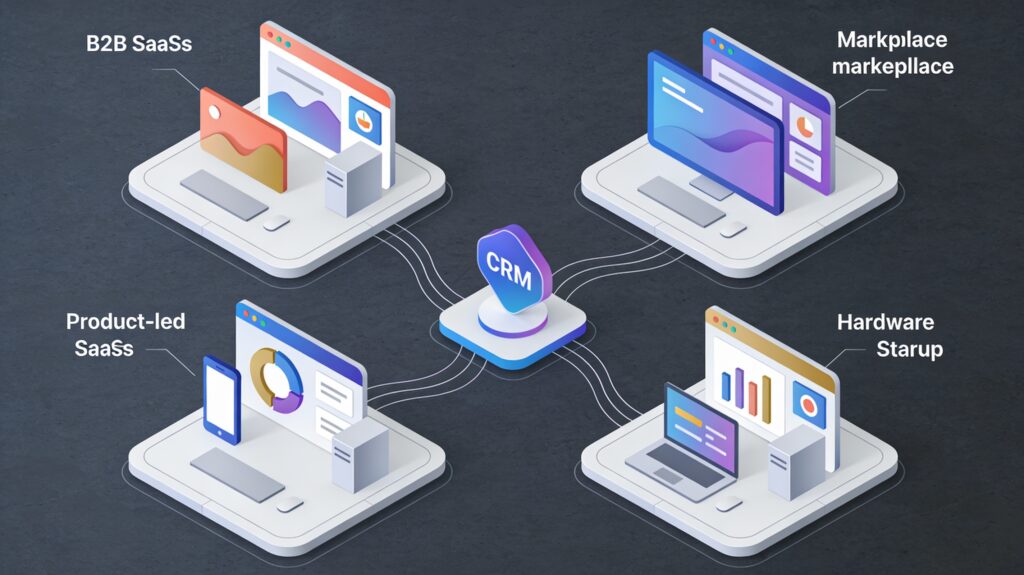
Not all startups are the same. A B2B SaaS startup, a marketplace, a fintech platform, and a hardware startup all have different sales and customer management needs. Here is how to think about CRM fit for common startup types.
You are selling an upmarket B2B product, and the founder or a founding team member is doing the sales.
Your sales cycle is longer than typical (maybe 60 to 120 days from first call to contract).
You need to track complex, multi-stakeholder deals where different people at the customer influence the decision.
What you need from a CRM:
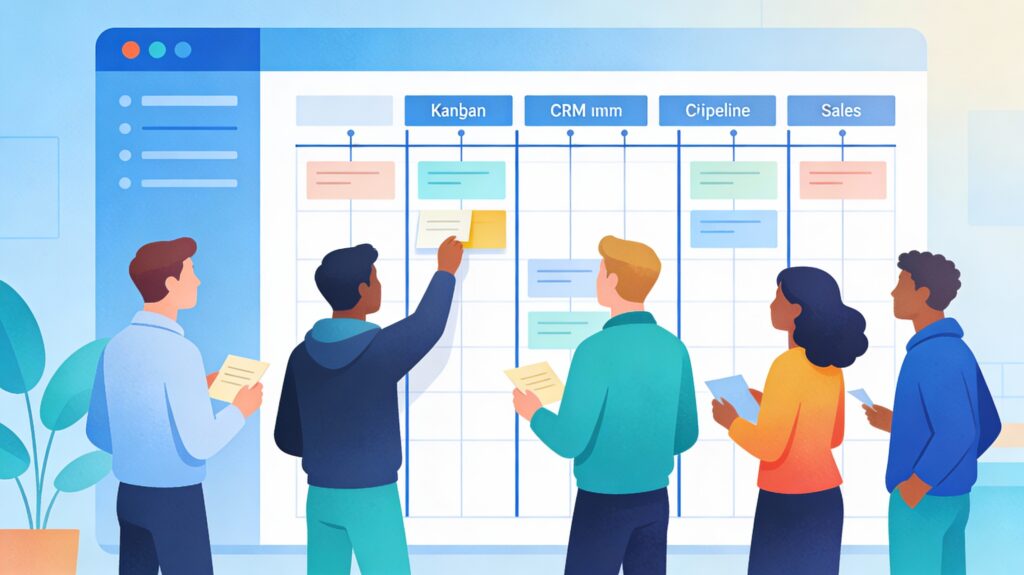
A clear pipeline view so you understand how many deals are at which stage.
The ability to add custom fields for the information that matters to your sale (budget, decision timeline, stakeholder list, etc.).
Email integration so that your interactions with prospects are automatically logged.
Recommended approach:
Start with a lightweight pipeline CRM. You need pipeline visibility and basic reporting more than you need automation or advanced analytics. As you grow and bring on a second sales person, the tool will need to support role-based permissions and team forecasting, but you do not need that today.
Archetype 2: Product-Led SaaS Growth
Profile:
Users sign up for a free trial or freemium plan without talking to your sales team.
Your sales role is land expansion (upselling existing users) or helping high-intent trial users convert to paid.
You need to understand user behavior inside the product to prioritize outreach.
What you need from a CRM:
Integration with your product analytics or event tracking so you can see user behavior in the CRM.
A simple way to log outreach and nurture attempts without requiring a complicated automation setup.
Recommended approach:
Choose a CRM that integrates with your product stack (Amplitude, Mixpanel, Segment, etc.) or offers native product analytics integration. For many product-led startups, a lightweight CRM paired with good analytics is better than a heavyweight CRM pretending to do analytics.
Archetype 3: Marketplace or Community Platform
Profile:
You are building a marketplace or community connecting supply and demand (freelancers and clients, sellers and buyers, mentors and learners, etc.).
Your customer base is diverse and your needs are less “sales pipeline” and more “user health and engagement tracking.”
You need to track onboarding progress, first transaction milestones, and churn risk.
What you need from a CRM:
Contact management that can track multiple user types (suppliers, buyers, etc.) with different attributes.
Activity logging to see who is engaging and who is dormant.
Segmentation so you can target different user cohorts with different messaging or offers.
Recommended approach:
A flexible, contact-centric CRM works better than a sales-pipeline CRM. You are managing a community, not a sales funnel, so choose tools that excel at tracking engagement and lifecycle, not just pipeline stage movement.
Archetype 4: Hardware or Physical Product Startup
Profile:
You are selling physical products, with longer sales cycles and often more complex distribution channels.
You may be selling direct-to-consumer, to retailers, through distributors, or some mix of all three.
Your “customers” might include end users, retailers, and distributors, each with different contact and relationship needs.
What you need from a CRM:
Account and contact management that supports multiple roles and channels.
Ability to link opportunities to distributor or retailer relationships so you understand your channels.
Good reporting on pipeline by channel (DTC vs wholesale vs distributor).
Recommended approach:
A general-purpose pipeline CRM with good account management is your safest bet. You will configure it to represent your sales channels and customer types, which takes more upfront work but gives you flexibility as your go-to-market evolves.
Startup CRM Red Flags: What to Avoid
As a startup evaluating CRM options, watch out for these patterns that often signal a bad fit for early-stage teams.
Requires a contract longer than one year – Early-stage startups pivot. Avoid multi-year commitments that lock you in if your go-to-market changes.
Expensive upfront setup – If the vendor wants thousands of dollars in implementation fees before you even get started, that is a sign the tool is not built for self-service startup adoption.
Salesy demo culture – Some vendors are notorious for “book a demo first” gatekeeping. If you cannot sign up and try the product yourself in 10 minutes, that is a red flag.
Overly complex interface – If the basic features (contacts, deals, notes) take time to find, the tool is not designed for small teams.
Weak mobile experience – As a startup, you are often on the move. If the mobile app is an afterthought, logging updates becomes friction.
The best CRM for startups gets out of your way. You should feel like the tool is helping you, not slowing you down.
Building CRM Discipline as You Grow
Picking the right CRM is only half the battle. The harder part is building the discipline to use it consistently, especially in a fast-moving startup where shortcuts feel natural.
Set a rhythm for pipeline reviews
Weekly, sit down with your CRM and review the pipeline. What deals moved? Which ones are stalled? Where do you need to follow up? This takes 15 minutes and keeps everyone aligned on reality, not optimism.
Agree on deal stages up front
Before you start using the CRM, define what each deal stage means. “Initial conversation,” “Proposal sent,” “Negotiation,” “Won/Lost.” If stages are fuzzy, your pipeline reporting will be useless.
Log activities consistently
If only the founder logs CRM notes and no one else does, the system becomes a personal notebook, not a team tool. Build the habit of logging calls, emails, and next steps as a team.
Automate what you can, but do not over-engineer
If your CRM offers email integration or task automation, set up the basics (auto-log emails, auto-create follow-up tasks). But do not spend weeks configuring advanced workflows. Keep it simple and iterate later as you understand what you actually need.
The Startup CRM Mindset: Lean, Honest, Scalable
Your CRM is not a status symbol. You do not need the most expensive tool or the one with the longest feature list. You need a tool that honestly reflects where your business is today: early, uncertain, and growing fast.
The best CRM for startups is the one that your team will actually use, that gives you visibility into your pipeline, and that scales with you as you grow from zero to your first million dollars in revenue. Whether that is a lightweight, $25-per-month solution or a mid-market platform with more features, pick the one that fits your current reality and gives you the option to grow without forcing a migration in year two.
The companies that build strong CRM discipline early—even in chaos and uncertainty—make better decisions about where to focus their limited resources. Start simple, stay consistent, and let your tool evolve as your business does.