Stripe vs Paddle vs Chargebee: Best Billing Software for SaaS Startups in 2026
June 23, 2026
0
Billing infrastructure looks like a boring back-office decision until you get it wrong. Then it becomes the problem that slows down pricing experiments, creates international compliance exposure, and
Billing infrastructure looks like a boring back-office decision until you get it wrong. Then it becomes the problem that slows down pricing experiments, creates international compliance exposure, and produces dunning workflows so fragile that recovering failed payments requires engineering time you don’t have.
The three tools founders compare most in 2026 — Stripe, Paddle, and Chargebee — look similar from the outside. All three handle subscriptions. All three process payments. And all three integrate with the major CRMs and accounting tools. But they operate on fundamentally different philosophies, and the wrong choice at the wrong stage creates friction that compounds for years.
This comparison cuts through the surface-level feature lists to explain what actually separates these three platforms.
The Core Distinction: What Kind of Problem Are You Buying?
Before comparing features, it helps to understand what problem each tool was built to solve.
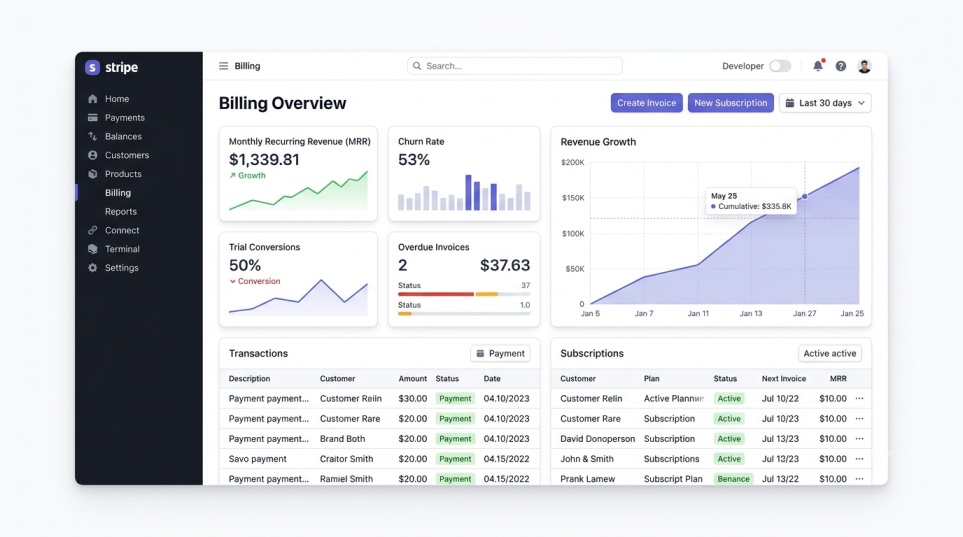
Stripe is a payment infrastructure company first. Stripe Billing is a subscription layer built on top of that infrastructure. It gives developers maximum control and flexibility — but it also means you own more: billing state management, tax wiring, proration rules, retry logic, and international compliance.
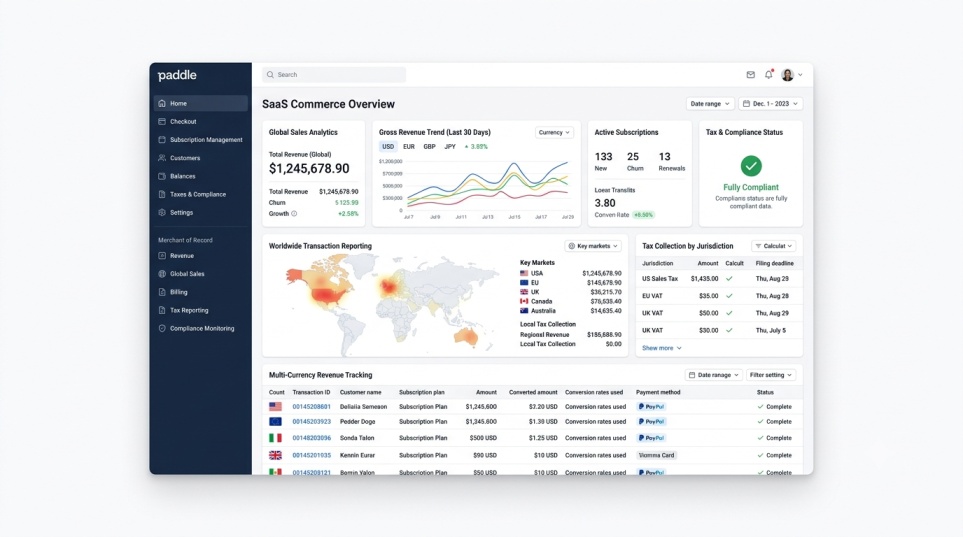
Paddle is a Merchant of Record (MoR). This is the key distinction. When you use Paddle, Paddle is legally the seller of your software. Customers transact with Paddle, not with you. Paddle collects and remits VAT, GST, and US sales tax across 180+ countries. Chargebacks, tax audits, and payment disputes go to Paddle — not your finance team. You receive revenue minus Paddle’s fee.
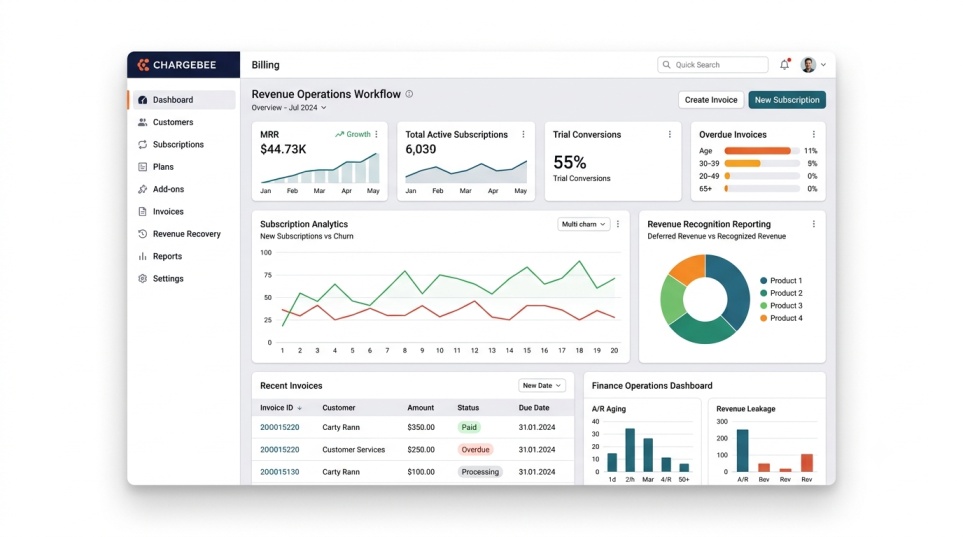
Chargebee is a subscription billing and revenue operations platform. It sits on top of a payment gateway — usually Stripe or Braintree — and adds subscription lifecycle management, complex invoicing, revenue recognition, dunning automation, and finance workflows that a gateway alone cannot provide.
Understanding this distinction determines which tool is relevant to your situation before you look at a single pricing page.
Stripe Billing: Maximum Flexibility, Maximum Ownership
Stripe Billing is the default choice for developer-led SaaS startups — and it earns that position. Its API is the best in the industry. If you can describe a billing model in words, Stripe can probably implement it. Usage-based billing, tiered pricing, flat-rate subscriptions, hybrid models. If you need a refresher on how these SaaS pricing models compare in practice, Stripe added native real-time metering for usage-based billing in 2026 and can support nearly all of them.
The ecosystem advantages are also real. If you are already using Stripe for payment processing, adding Stripe Billing means one platform, one integration, one reconciliation workflow. Stripe Tax, Stripe Radar for fraud prevention, Stripe Checkout, and Stripe Revenue Recognition all connect without additional engineering.
What Stripe Billing Costs
Stripe’s base payment processing fee is 2.9% + $0.30 per transaction. Stripe Billing adds 0.7% of billing volume on top of that for subscription management. For a business processing $100,000 MRR, the combined fees approach $3,600/month before any international processing premiums or currency conversion costs.
Where Stripe Falls Short
Stripe is a payment processor, not a Merchant of Record. That means international tax compliance remains entirely your responsibility. As you acquire customers across EU countries, Australian markets, Canadian provinces, and US states with nexus requirements, the operational burden of registering, collecting, and remitting the correct taxes grows dramatically. Stripe Tax helps automate calculation, but the legal liability stays with you.
For non-technical billing needs, complex invoicing workflows, revenue recognition for ASC 606 compliance, multi-entity billing across subsidiaries, or the kind of dunning logic that a finance team manages rather than an engineering team — Stripe Billing starts showing its limits above roughly $50,000–$100,000 MRR.
Best for: Developer-led startups under $100K MRR, primarily domestic customers, teams already on the Stripe ecosystem, and companies building custom billing logic that off-the-shelf tools cannot support.
Paddle: Compliance by Design
Paddle takes a categorically different approach. As a Merchant of Record, it assumes legal responsibility for the entire transaction, tax calculation, collection, filing, and remittance across all jurisdictions. For a small SaaS team without a dedicated finance function, the removal of liability is genuinely transformative.
The value proposition is clearest for software companies selling globally from day one. Instead of hiring a tax consultant, registering in multiple jurisdictions, and managing quarterly filings as your customer geography expands, Paddle handles all of it. Paddle markets a total cost of ownership reduction of up to 25% compared to alternatives that require separate payment processing, tax automation, and compliance infrastructure.
What Paddle Costs
Paddle charges 5% + $0.50 per transaction. Compared to Stripe’s 2.9% + $0.30, this looks expensive. But the comparison is not apples-to-apples. Paddle’s fee includes payment processing, subscription management, tax handling, and chargeback management. To replicate that with Stripe, you would add Stripe Billing (0.7%), Stripe Tax, potentially a third-party dunning tool, and the labor cost of managing international compliance — at which point total costs often converge or exceed Paddle’s transparent fee.
Where Paddle Falls Short
The MoR model comes with trade-offs. Paddle is the legal seller, which means some customers will see Paddle’s name on their payment confirmation rather than yours. That affects brand perception in some contexts. More practically, Paddle is designed for digital products and standard SaaS billing models. Highly custom payment flows, physical goods, and marketplace architectures fall outside its scope. If your billing model is genuinely unusual, Paddle’s checkout customization options may feel constraining compared to Stripe’s raw flexibility.
Best for: SaaS startups selling internationally, small teams without a dedicated finance function, founders whose primary operational fear is global tax and compliance exposure, and companies that want one vendor for payments, subscriptions, and compliance.
Chargebee: Revenue Operations Infrastructure
Chargebee occupies a different category than Stripe or Paddle. It is not a payment processor, and it is not a Merchant of Record. It is a subscription billing and revenue operations layer that sits on top of a payment gateway — typically Stripe, Braintree, or Adyen- and adds the organizational depth that a gateway alone cannot provide.
The use case for Chargebee becomes clear when billing outgrows the engineering team. Annual contracts with custom terms, mid-cycle upgrades and downgrades, prorated invoice calculations, multi-currency billing, revenue recognition compliant with ASC 606 and IFRS 15, dunning workflows with smart retry logic, all of these require operational infrastructure that Stripe Billing was not designed to own.
Chargebee also shines in B2B SaaS environments where the finance team, sales ops, and customer success all interact with billing data. Its two-way CRM sync with Salesforce and HubSpot is the deepest of the three platforms. For organizations where a contract amendment in Salesforce needs to flow into billing automatically, Chargebee provides that workflow; Stripe does not natively.
What Chargebee Costs
Chargebee’s Starter plan is free until you have processed $250,000 in cumulative lifetime billing — not monthly, lifetime. That is a genuinely useful runway for early-stage startups. Beyond that, paid plans start at $249/month and scale with MRR volume. Chargebee still requires a payment processor, so you add Stripe or Braintree fees on top.
Where Chargebee Falls Short
Chargebee adds a second system to maintain. You now have your payment gateway and your billing layer — two integrations, two points of potential failure, and two vendor relationships. For early-stage startups that just need a clean checkout and basic recurring payments, Chargebee’s configuration depth can become a liability rather than a feature. It is also not a Merchant of Record, so international tax compliance still sits with your organization.
Best for: Scaling B2B SaaS companies above $50,000–$100,000 MRR, teams with complex billing catalogs or contract structures, organizations where billing is a finance operations problem rather than an engineering one, and companies that need revenue recognition compliance.
Head-to-Head Comparison Table
Feature
Stripe Billing
Paddle
Chargebee
Model
Payment processor + billing
Merchant of Record
Billing layer (on top of gateway)
Base fee
2.9% + $0.30 + 0.7% billing
5% + $0.50
From $249/mo + gateway fees
Free tier
Yes (usage-based)
No
Yes (up to $250K lifetime billing)
Tax compliance
Your responsibility
Fully handled
Your responsibility
International VAT/GST
Stripe Tax (additional)
Included
Avalara or manual
Merchant of Record
No
Yes
No
Custom checkout
Fully custom
Limited customization
Via gateway
Usage-based billing
Yes (native, 2026)
Yes
Yes
Revenue recognition
Stripe Revenue Recognition
Limited
ASC 606 / IFRS 15 compliant
CRM sync
Webhooks required
Basic
Deep (Salesforce, HubSpot)
Dunning automation
Basic
Included
Advanced with smart retries
Best stage
Seed to $100K MRR
Any stage, global sellers
$50K+ MRR, B2B complexity
How to Decide: A Practical Framework
Stop comparing feature checklists. Instead, answer three questions honestly.
1. Are you selling internationally right now, or will you be within 12 months? If yes, the compliance burden of managing VAT, GST, and US sales tax nexus across multiple jurisdictions is real and growing. Paddle removes that burden entirely. Stripe Tax helps automate calculation, but leaves legal liability with you. This is the single most important decision factor for globally ambitious startups with small teams, and especially for bootstrapped SaaS companies that cannot afford a dedicated finance or compliance function
2. How technical is your billing logic? If your pricing model is unusual — deeply custom usage metering, complex hybrid plans, or marketplace-adjacent billing — Stripe’s API gives you the flexibility to build it. Paddle and Chargebee are designed for standard SaaS billing patterns. Unusual billing requirements should push you toward Stripe.
3. Is billing becoming a finance operations problem or an engineering problem? Below $50,000 MRR, billing is mostly an engineering problem. Above that threshold, finance teams start caring about invoice formats, revenue recognition, contract amendments, and dunning workflows in ways that Stripe Billing alone cannot elegantly support. That is when Chargebee’s operational depth starts paying for itself.
A Note on Migration Costs
Switching billing platforms after scale is expensive — not necessarily in software fees, but in engineering time, subscription migration risk, and revenue recognition restatement. Getting this decision right early matters.
The most common mistake is optimizing for launch speed and discovering six months later that the billing stack cannot support the pricing experiments the product team wants to run. Start with the tool that fits your next 12 months of pricing changes, not your current sprint.
FAQ
What is a Merchant of Record?
A Merchant of Record (MoR) is the legal entity responsible for processing payments and managing tax compliance for a transaction. When Paddle acts as your MoR, Paddle — not your company — is legally the seller. Paddle handles tax collection, remittance, chargebacks, and compliance across all jurisdictions.
Is Paddle more expensive than Stripe?
Paddle’s 5% + $0.50 fee is higher than Stripe’s base rate. However, when you factor in Stripe Billing’s additional 0.7%, Stripe Tax, and the labor cost of managing international compliance, the total cost of ownership is often comparable — particularly for companies selling globally.
When should I switch from Stripe to Chargebee?
Most practitioners recommend evaluating Chargebee when you reach $50,000–$100,000 MRR and need advanced dunning, revenue recognition, or complex pricing models. The monthly platform fee becomes justifiable once billing complexity becomes a finance operations problem.
Can I use Chargebee with Paddle?
No — Chargebee requires a traditional payment gateway as its underlying processor. Because Paddle acts as the Merchant of Record and owns the payment relationship, it does not function as a gateway that Chargebee can sit on top of. They solve adjacent but distinct problems.
Does Stripe support usage-based billing? Yes. Stripe added native usage-based billing with real-time metering in 2026, making it a more complete option for API and developer-tool companies on consumption pricing models.
Final Verdict
Stripe is the right default for developer-led startups with simple billing needs, primarily domestic customers, and engineering resources to maintain the stack. It is the fastest path to market and the most flexible foundation for custom billing logic.
Paddle is the right choice when international compliance is a present or near-term concern. For a small team without a dedicated finance function, the MoR model pays for the fee premium many times over in reduced legal and operational overhead.
Chargebee becomes the right answer when your billing model has grown complex enough that it requires a dedicated tool, not just a payment processor with billing added on. That typically means B2B SaaS above $50K–$100K MRR with enterprise contracts, complex dunning requirements, or multi-entity revenue recognition needs.
Most startups should start with Stripe, evaluate Paddle if international customers create compliance friction, and consider Chargebee once the finance team starts asking questions that the payments dashboard cannot answer.