


Asana vs Monday.com Pricing 2026, Which Plan Is Actually Better Value
- September 2, 2026
- 0
Monday.com is the cheaper platform at every published tier, and for small and mid-size teams it is usually the better value too. Asana closes that gap once a

Monday.com is the cheaper platform at every published tier, and for small and mid-size teams it is usually the better value too. Asana closes that gap once a
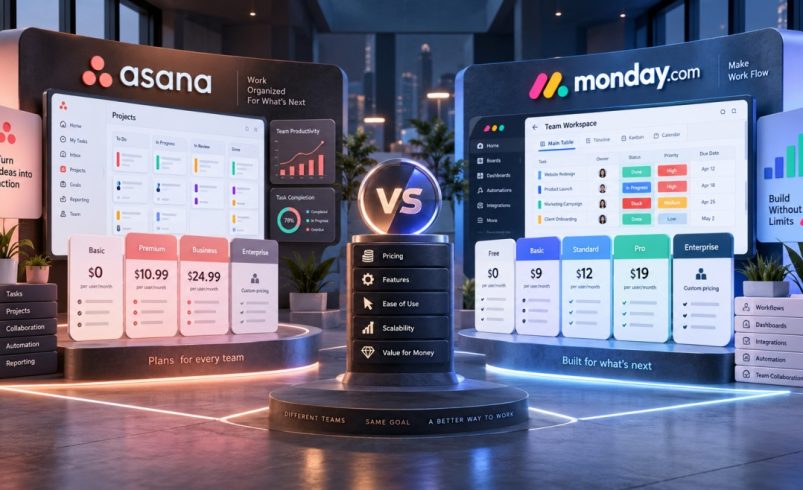
Monday.com is the cheaper platform at every published tier, and for small and mid-size teams it is usually the better value too. Asana closes that gap once a team needs portfolio reporting, goal tracking, or native time tracking, because those land inside its $24.99 Advanced plan while the closest matching features on Monday.com sit behind a $19 Pro tier built more for automation and private boards than for program-level oversight. There is no single universal winner here. The right plan depends on team size, how much of the software actually gets used, and whether a lower sticker price stays lower once seat minimums and add-ons are counted.
Both companies publish list pricing per seat, per month, with a discount for paying annually. Here is where the two line up as of late August 2026, verified against Asana’s pricing page and monday.com’s pricing page.
| Plan tier | Asana | Monday.com |
| Free plan | Personal, capped at 2 users | Free, capped at 2 seats |
| Entry paid plan | Starter, $10.99/user/mo annual ($13.49 monthly) | Basic, $9/seat/mo annual ($12 monthly) |
| Mid paid plan | Advanced, $24.99/user/mo annual ($30.49 monthly) | Standard, $12/seat/mo annual ($14 to $15 monthly) |
| Top named plan | None, jumps straight to Enterprise | Pro, $19/seat/mo annual ($24 monthly) |
| Enterprise | Custom, contact sales | Custom, contact sales |
| Minimum paid seats | 2 | 3 |
The gap that jumps out immediately is that Monday.com has a third named tier, Standard, sitting between its cheapest paid plan and its most capable one, while Asana goes straight from Starter to Advanced with no middle step. That structural difference shapes a lot of the value comparison below.
Asana Personal is free for up to two people and covers list, board, and calendar views with unlimited tasks and projects, which makes it fine for an individual or a two-person team testing the tool rather than a working plan for anyone larger.
Starter, at $10.99 per user per month on annual billing, is where Asana actually becomes usable for a team. It adds timeline and Gantt views, a workflow builder, custom fields, forms, and unlimited automations, on top of Asana AI. This is the plan that covers most day-to-day project tracking, and Asana positions Starter as the plan most growing teams should land on.
Advanced, at $24.99 per user per month annual, is a meaningfully bigger jump, more than double Starter’s price. What it buys is unlimited portfolios, portfolio workload views, Goals, native time tracking, and integrations with tools like Salesforce, Tableau, and Power BI. A ten-person team on Starter pays roughly $1,319 a year. The same ten people on Advanced pay close to $3,000, an extra $1,680 for portfolio and goal management alone.
Enterprise and Enterprise Plus are quote-only, aimed at organizations that need SSO, SCIM provisioning, data residency, and audit logging, and Asana does not publish a number for either tier.
Monday.com’s free plan is similarly capped at two seats and three boards, useful for evaluation but not for a working team.
Basic, at $9 per seat per month annual, lifts the board cap and adds unlimited items with 5GB of storage per seat, but it does not include automations or integrations at all. That is a meaningful gap. A team on Basic ends up manually updating statuses and moving items between stages by hand.
Standard, at $12 per seat per month annual, is the plan most reviewers and Monday.com’s own materials point to as the one most teams should actually buy. It adds timeline and calendar views, guest access, integrations with Slack and Google Drive, 20GB of storage per seat, and 250 automation and integration actions a month.
Pro, at $19 per seat per month annual, adds time tracking, formula columns, dependency management, private boards, 100GB of storage per seat, and a much larger 25,000 monthly action allowance for automations and integrations. It is the first tier where Monday.com starts to compete directly with what Asana includes in Advanced, though the two platforms are not building toward the exact same feature set even at comparable prices.
All paid Monday.com plans require a minimum of three seats, a rule monday.com’s own support documentation confirms, so a solo user or a two-person team pays for a phantom third seat no matter which paid tier they pick.
List price, annual billing, before add-ons.
| Team size | Asana Starter | Asana Advanced | Monday Standard | Monday Pro |
| 5 users | $660/year | $1,499/year | $720/year | $1,140/year |
| 10 users | $1,319/year | $2,999/year | $1,440/year | $2,280/year |
| 20 users | $2,638/year | $5,998/year | $2,880/year | $4,560/year |
At every size shown, Monday.com Standard undercuts Asana Starter by a modest amount, and Monday.com Pro undercuts Asana Advanced far more, since the price jump from Starter to Advanced is proportionally larger on Asana than the jump from Standard to Pro is on Monday.com. For a twenty-person team choosing between each platform’s top named plan, Monday.com Pro comes in roughly 24 percent cheaper than Asana Advanced, a difference worth close to $1,400 a year at that size.
That said, raw seat cost only tells part of the story. Asana Advanced’s Goals and portfolio workload views solve a real problem for program managers overseeing multiple projects at once, a use case Monday.com Pro does not directly address in the same way.
Neither company’s free plan is meant for anything past a two-person evaluation, and both push new users toward a paid tier quickly. The more interesting comparison sits at the entry paid tier. Asana Starter includes automations and workflow building from day one. Monday.com Basic, at a lower price, strips automations and integrations out entirely and reserves them for Standard. That makes Basic a weaker starting point than its price tag suggests. Most teams evaluating Monday.com should budget for Standard, not Basic, which narrows the headline price gap between the two platforms considerably.
Asana sells a Timesheets and Budgets add-on at $5.99 per user per month on annual billing, which is not included in Starter or Advanced and applies per person rather than per team. For a twenty-seat Advanced deployment that needs it, the add-on adds roughly $1,438 a year on top of seat costs.
Monday.com’s hidden cost shows up earlier, in the three-seat minimum on every paid plan. A one or two-person team is still billed for three seats, which effectively raises the entry price for the smallest buyers.
Both platforms also increase list price by 18 to 30 percent for monthly billing compared with annual, so any serious cost comparison should run on annual numbers. Independent contract benchmarking from Vendr shows buyers commonly negotiate below list price on Monday.com at higher seat counts, though that leverage mostly applies above fifty seats and does little for smaller teams paying list price.
Small teams and solo founders testing project tracking for the first time get more usable functionality per dollar from Monday.com Standard, since it includes automations and integrations at a price below Asana Starter.
Growing teams of ten to twenty five people that need consistent process automation, custom fields, and forms, without heavy cross-project reporting, are well served by either Asana Starter or Monday.com Standard, and the decision comes down more to interface preference than price at this size.
Teams managing several concurrent projects that need portfolio-level visibility, resource workload views, and company goal tracking get more direct value from Asana Advanced than from Monday.com Pro, even though Advanced costs more, because Monday.com does not offer an equivalent portfolio and goals layer at any published tier short of Enterprise.
Agencies and cross-functional teams juggling heavy automation volume, private client boards, and detailed time tracking on a budget tend to land on Monday.com Pro, which is priced well below Asana Advanced while covering most of the same day-to-day operational ground.
For a broader look at how Monday.com stacks up against another major competitor on price and features, see SaaSComparely’s Monday.com vs ClickUp comparison. Teams evaluating developer-focused alternatives instead may find the Linear vs Jira pricing breakdown or Jira’s own 2026 pricing guide more directly relevant.
Monday.com is the better value for teams under roughly fifteen people that need solid automation and integration coverage without paying for portfolio management they will not use. Its Standard plan undercuts Asana Starter on price while matching most of what a mid-size team actually touches day to day.
Asana earns its higher price once a team’s real bottleneck is program-level visibility across multiple projects rather than task tracking inside one. Advanced’s Goals, portfolio workload, and native time tracking are not features Monday.com replicates at a comparable price point, and for a program manager overseeing several teams that gap is worth the extra cost.
Neither platform is cheaper in every scenario, and neither is better value in every scenario. The honest read for 2026 is that Monday.com wins the pure cost comparison at almost every seat count, while Asana wins the value comparison specifically for teams whose problem is coordinating across projects rather than completing tasks inside one.