PostHog vs Amplitude vs Mixpanel: Best Product Analytics Tool for Startups
June 27, 2026
0
Two years ago, this comparison had a stable structure: Amplitude was the serious enterprise analytics platform, Mixpanel was the friendlier alternative, and PostHog was the scrappy open-source option
Two years ago, this comparison had a stable structure: Amplitude was the serious enterprise analytics platform, Mixpanel was the friendlier alternative, and PostHog was the scrappy open-source option that engineers loved, and product managers were skeptical of. That structure no longer holds.
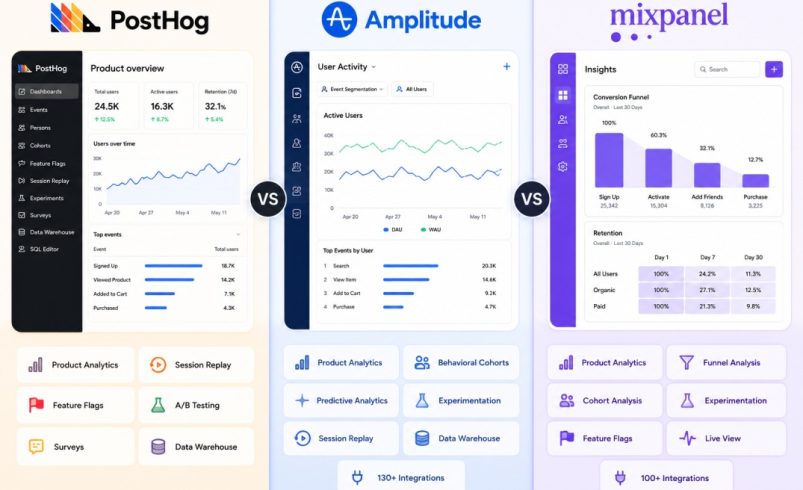
In 2026, all three platforms have moved significantly. Mixpanel relaunched experimentation and feature flags after previously discontinuing them. Amplitude has leaned hard into AI-powered behavioral analysis and breadth-first platform expansion. And PostHog, arguably the most interesting story of the three, has built an all-in-one product platform so comprehensive and priced it so aggressively that it has forced both competitors to rethink their positioning.
The choice between these three tools is no longer primarily about features. It is about team composition, organizational workflow, and what you actually need product analytics to do.
What Separates These Three Platforms
The surface-level pitch from all three is similar: track user behavior, understand funnels, analyze retention, and improve your product. The meaningful differences only surface when you look at architecture, depth, and who the tools are built for.
PostHog: The All-in-One Insurgent
PostHog has redefined the product analytics category by refusing to be just a product analytics tool. The current platform bundles product analytics, session replay, feature flags, A/B testing, surveys, error tracking, LLM observability, and a built-in data warehouse under a single SDK and a single data model.
The operational advantage of that integration is real and difficult to replicate with a fragmented stack. When a user drops off in a PostHog funnel, you click a button and watch a session recording of exactly that user at exactly that step. Then you can check whether they were in a feature flag experiment, whether an error occurred during their session, and what they said in the in-app survey you deployed at that step, all without leaving the platform. That closed-loop workflow saves significant debugging and investigation time.
PostHog’s pricing philosophy is also unusual. The free tier includes 1 million analytics events, 5,000 session replays, 1 million feature flag requests, and 1,500 survey responses per month — with unlimited seats and no “talk to sales” gates on core features. More than 90% of PostHog customers use it entirely for free. The startup program adds $50,000 in credits on top of that. A fully-featured setup for a 60-person SaaS company typically runs $200–$400 per month.
What PostHog does well:
Engineering workflow integration, all-in-one data model, transparent pricing, generous free tier, open-source foundation with self-hosting option for data sovereignty, and direct SQL access for technical users.
Where PostHog falls short:
The UI, while much improved, is still built for engineers. Non-technical PMs who need to self-serve answers without touching SQL will find the experience rougher than Mixpanel. The platform’s breadth also means no single capability is as deep as a dedicated best-of-breed tool. PostHog’s session replay is not FullStory. Its feature flags are not LaunchDarkly. Its analytics are not Amplitude. But for teams that want all of those capabilities in one place at a fraction of the cost, the combination frequently wins.
Amplitude: Depth and Behavioral Science
Amplitude is the platform you reach for when analytics becomes a company-wide capability rather than just a dashboard that one product manager checks. Its behavioral cohort analysis, predictive segmentation, and cross-functional reporting depth are still ahead of the competition for data-heavy organizations.
The Compass feature automatically identifies behavioral predictors of retention — surfacing which user actions in week one correlate with 90-day retention without you having to know what to look for. For PLG teams trying to identify their activation metric scientifically, that kind of automated analysis provides genuine value. The AI features on Growth and Enterprise plans extend this into natural language querying and automated insight surfacing.
Amplitude’s cross-tool integrations are also its competitive advantage for larger organizations. With 130+ native integrations including Salesforce, HubSpot, Braze, and all major data warehouses, it sits well at the center of a mature analytics stack. Its experiment and session replay capabilities, available on higher-tier plans, have improved meaningfully.
What Amplitude does well: Deep behavioral cohort analysis, predictive analytics, multi-team governance, cross-functional reporting, and enterprise integrations.
Where Amplitude falls short: The free tier caps at 10,000 monthly tracked users — far more restrictive than PostHog or Mixpanel. Beyond that, pricing is custom and opaque, with enterprise contracts ranging from $50,000 to $200,000+ per year. The gap from free to paid is the steepest of the three. The interface is clinical and data-science-oriented, which non-technical teams consistently find harder to navigate. For early-stage startups, Amplitude’s depth is often more than they need — and the pricing reflects that.
Mixpanel: Speed to Insight
Mixpanel has earned its position as the fastest path from zero to useful product analytics. Its event-based tracking model and drag-and-drop interface let non-technical product managers and marketers build complex funnel analyses, retention curves, and cohort comparisons in minutes, without writing SQL or involving engineering.
Mixpanel’s funnel builder is where it genuinely pulls ahead. Complex conversion flows with multiple paths, time constraints between steps, and multi-dimensional breakdowns are accessible to non-technical users through an interface that makes the analysis feel natural rather than technical. The retention reports offer multiple calculation methods — N-day, unbounded, and bracket retention, which answer different questions about user behavior.
The free tier is competitive: 1 million events per month, and the startup program provides one year free with up to 1 billion events. That runway covers most startups well past Series A.
What Mixpanel does well: Non-technical self-service, fast implementation, clean behavioral analytics, strong funnel and retention analysis, and the most polished interface of the three.
Where Mixpanel falls short: No native session replay. To get session replay alongside Mixpanel, you need a separate tool — Hotjar at $80+/month, FullStory at $300+/month, or LogRocket at $99+/month — which meaningfully increases the total stack cost and introduces the data fragmentation problem that PostHog avoids by design. Group analytics for B2B account-level tracking, data pipeline exports, and several other features useful for growth-stage companies are add-ons on the Growth plan, which several users have flagged as a meaningful pricing trap. Mixpanel’s history of pricing model changes — it switched from MTU-based to event-based pricing previously — is worth noting for teams making long-term commitments.
Pricing: What You Actually Pay
Pricing comparisons in this category require careful attention to model, not just headline numbers.
Plan Level
PostHog
Mixpanel
Amplitude
Free tier
1M events, 5K replays, 1M flag requests, unlimited seats
1M events/mo
10K MTUs/mo
Paid starting price
~$200–400/mo (full feature stack)
$28/mo (Growth, event-based)
Custom (sales required)
Session replay
Included
Not included
Add-on
Feature flags
Included
Add-on (relaunched 2025)
Not native
Self-hosting
Yes (free, open-source)
No
No
Data retention (free)
1 year
Unlimited
Unlimited
Pricing transparency
High
Medium
Low
One important nuance on the PostHog pricing: every product in the suite — analytics, replays, flags, surveys — has its own usage meter. The pricing is transparent, but it is also modular. Teams need to model their expected usage across each dimension to accurately forecast costs as they scale.
Amplitude’s “Monthly Tracked Users” model creates a different dynamic: a power user who generates 100 events counts as 1 MTU. For applications with high engagement per user — think daily-active developer tools or productivity apps — Amplitude’s MTU pricing can be meaningfully cheaper than event-based pricing at scale. For applications with many low-engagement users, event-based pricing wins. Know your engagement pattern before choosing.
Team Fit: The Most Important Factor
Analytics tool decisions fail most often when the buying team optimizes for features and ignores workflow reality.
Engineering-led founding teams — where developers own the product analytics workflow and are comfortable with SQL — consistently get the most value from PostHog. The depth of the platform, the open-source foundation, and the data control advantages are uniquely valuable to teams that think in those terms. Self-hosting on your own infrastructure is also possible, which matters for companies with data residency requirements.
Product-led teams with non-technical PMs — where product managers and marketers need to self-serve answers without engineering involvement — are better served by Mixpanel. The investment in user experience shows in every part of the interface, and the time-to-first-insight advantage is real for teams that cannot afford to wait for engineering to pull data.
Enterprise or data-science-heavy organizations — where analytics is a company-wide capability owned by multiple teams including data scientists, growth teams, and leadership — are the natural Amplitude customers. The governance features, the depth of behavioral analysis, and the integration breadth justify the complexity and the price at that scale.
The Stack Fragmentation Question
The most important strategic question in this comparison is not which tool has the best funnel builder. It is whether you want a best-of-breed analytics stack or an all-in-one product platform.
Amplitude and Mixpanel follow the best-of-breed philosophy. They aim to be the best analytics engine, and nothing else. Needing session replay means adding Hotjar or FullStory. A/B testing means adding VWO or Optimizely. Feature flags means adding LaunchDarkly or a PostHog add-on. Connecting those tools requires a CDP like Segment or RudderStack to maintain data consistency. A full best-of-breed stack covering all of these capabilities can easily cost $1,000–$3,000/month for a growth-stage startup.
PostHog takes the all-in-one approach. One SDK, one data model, one billing relationship, and a stack that covers the majority of PLG analytics use cases without integration work. That is a genuine trade-off — PostHog’s individual modules are not as deep as dedicated best-of-breed alternatives, but for teams that are optimizing for velocity and lean operations rather than maximum analytical depth, the trade-off often makes sense.
Head-to-Head: Which Specific Scenarios Favor Each Tool
Choose PostHog if:
Your founding team is engineering-heavy and comfortable with technical tools
You want analytics, session replay, feature flags, and A/B testing in a single platform
Keeping costs low before product-market-fit is a priority
Data sovereignty or self-hosting is a requirement
You want the most generous free tier in the category
Choose Mixpanel if:
Non-technical PMs and marketers need to self-serve analytics without engineering help
You want the fastest time-to-first-insight for behavioral analytics
You are an early-stage startup that qualifies for the one-year-free startup program
You are comfortable sourcing session replay separately
Whereas choose Amplitude if:
Your company has a dedicated data science or analytics team
You need enterprise-grade governance, naming standards, and cross-team analytics ownership
Behavioral prediction and automated insight surfacing justify the platform’s complexity
You are a late-stage company where analytics is a company-wide infrastructure investment
FAQ
What is the difference between PostHog and Mixpanel?
PostHog is an all-in-one product platform built for engineers, bundling analytics, session replay, feature flags, A/B testing, and surveys in a single open-source platform. Mixpanel is a focused behavioral analytics tool optimized for non-technical product and marketing teams who need fast, self-serve insights. PostHog offers a more generous free tier; Mixpanel offers a more accessible interface.
Is PostHog really free?
PostHog’s free tier includes 1 million analytics events, 5,000 session replays, 1 million feature flag requests, and 1,500 survey responses per month with unlimited seats. More than 90% of PostHog customers use it entirely for free. The startup program adds $50,000 in additional credits.
Does Mixpanel include session replay?
No. Mixpanel relaunched feature flags and experimentation in late 2025 but does not include native session replay. Teams using Mixpanel for analytics need a separate session replay tool like Hotjar, FullStory, or LogRocket.
When does Amplitude become worth the price?
Amplitude’s depth and pricing justify themselves when analytics becomes a company-wide capability owned by multiple teams — typically larger organizations with dedicated data science functions, or enterprise companies that need behavioral prediction and cross-team governance. Early-stage startups generally get more value per dollar from PostHog or Mixpanel.
Can I switch between these tools later?
Switching analytics platforms is possible but costly. Migrating event instrumentation, historical data, and team workflows takes significant engineering time. The decision deserves careful consideration upfront. Most teams that get this right choose based on team composition and 12-month growth trajectory, not just current features.
What is the MTU vs event pricing difference?
Amplitude charges by Monthly Tracked Users (MTUs); PostHog and Mixpanel charge by events. A power user generating 100 events per session counts as 1 MTU on Amplitude but 100 events on PostHog or Mixpanel. For high-engagement applications, Amplitude’s MTU pricing can be more economical at scale.
Final Verdict
PostHog is the most compelling analytics platform for engineering-led startups in 2026. The free tier is genuinely generous, the all-in-one model removes significant integration complexity, and the pricing transparency is unique in a category that typically hides its costs behind sales calls. For technical teams that can navigate its engineering-first interface, the value-to-cost ratio is difficult to argue with.
Mixpanel is the right answer when non-technical product and marketing teams need to own the analytics workflow. Its interface advantage is real, and the startup program gives early-stage companies meaningful runway. The need to source session replay separately is a genuine cost and complexity trade-off worth acknowledging.
Amplitude earns its seat at the table for organizations with mature analytics functions, dedicated data teams, and use cases where behavioral prediction and deep cohort analysis are central to the business. At the scale and complexity where Amplitude’s price is justifiable, it delivers analytical depth the other two cannot match.
The default recommendation for most startups reading this in 2026: start with PostHog on the free tier. If your non-technical team finds the interface creates friction, evaluate Mixpanel. If you outgrow both — meaning your analytics needs have become an organizational capability, not just a dashboard, then Amplitude becomes worth the conversation.