Zoho CRM vs Freshsales: Which Is Better for Mid-Market Teams?
July 20, 2026
0
Zoho CRM vs Freshsales comes up in almost every shortlist conversation once a sales team outgrows spreadsheets or a bare-bones pipeline tool. Both platforms sell themselves on the
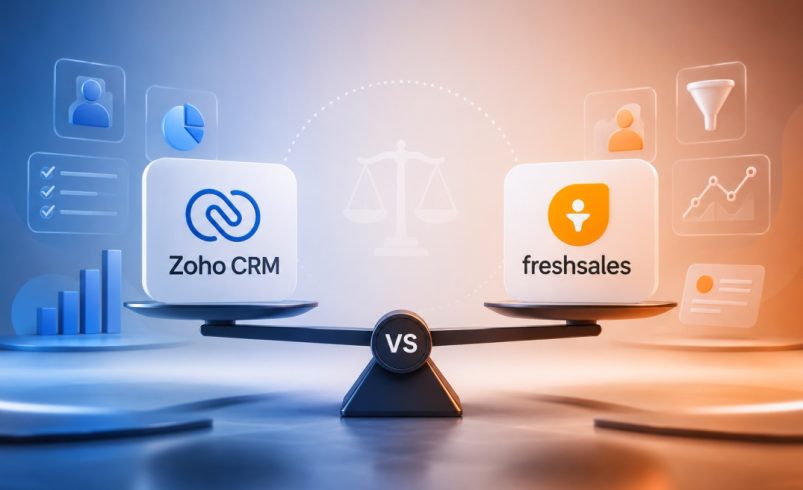
Zoho CRM vs Freshsales comes up in almost every shortlist conversation once a sales team outgrows spreadsheets or a bare-bones pipeline tool. Both platforms sell themselves on the same pitch: enterprise-grade automation and AI at a fraction of Salesforce pricing.
The difference only becomes clear once a team scales past ten or fifteen reps, where structure, support quality, and AI depth start to matter more than the number on the pricing page. This comparison looks at where the two platforms actually diverge for mid-market buyers in 2026, drawing on current pricing pages and verified G2 and Capterra review data.
What Zoho CRM and Freshsales Actually Do
Zoho CRM is the broader platform. It covers sales, marketing, and service in one system, backed by Zia, Zoho’s AI layer, and a deep bench of native modules for territory management, blueprints, and custom objects.
Freshsales, built by Freshworks, takes a narrower approach. It focuses on sales execution: pipeline visibility, built-in phone and chat, and Freddy AI for lead scoring. It trades some of Zoho’s configurability for a cleaner day-to-day interface.
Neither product is a bad choice on its own. The right pick depends on how much complexity a sales operation actually needs, and how much time a team has to configure and maintain the system it buys. Teams still under ten users and weighing lighter options should start with our best CRM software for small business comparison before narrowing to these two.
Zoho CRM vs Freshsales 2026: Pricing Breakdown
Pricing structure is where the two products start to look genuinely different, not just cosmetically different. Both list a usable free plan capped at three users, but the paid tiers diverge quickly.
Plan tier
Zoho CRM (per user/month, annual)
Freshsales (per user/month, annual)
Free
Free, up to 3 users
Free, up to 3 users
Entry
Standard: $14
Growth: $9
Mid
Professional: $23
Pro: $39
Upper
Enterprise: $40
Enterprise: $59
Top
Ultimate: $52
Not offered as a separate tier
Zoho’s Standard plan undercuts Freshsales’ Growth tier on raw features, since automation and custom modules show up earlier in Zoho’s ladder. Freshsales counters with a lower entry price and a more direct route into Freddy AI, though most of Freddy’s useful scoring features sit behind the Pro tier and above. Buyers weighing either platform against a wider set of budget-friendly options may also want our guide to affordable CRM software, since value-tier CRMs follow a different playbook entirely.
Figures reflect list pricing billed annually, drawn from Zoho’s official CRM pricing page and Freshworks’ published Freshsales pricing as of mid-2026. Vendors adjust pricing regularly, so confirm current numbers directly with each provider before budgeting.
AI Capabilities: Zia vs Freddy AI
Zia, Zoho’s AI assistant, now predicts deal outcomes, flags anomalies such as a sudden drop in lead conversions, and recommends the best time to contact a given prospect based on past engagement. It runs across the CRM rather than sitting in a single module, which is consistent with Zoho positioning AI as infrastructure rather than an add-on.
Freddy AI, Freshworks’ equivalent, focuses on contact scoring and deal insights. Independent testing found its lead scoring reasonably accurate at identifying already-engaged contacts, and its stale-deal flags matched reviewer expectations in most cases.
The gap shows up in scope. Freddy AI scores contacts already inside the CRM, but it does not identify anonymous website visitors or build outbound sequences on its own. Reps still decide who to call and when. Zia’s anomaly detection and forecasting reach further into pipeline strategy, which matters more once a team is managing multiple reps and territories. Buyers unsure how to weigh AI claims against actual usefulness can read our breakdown on AI-native CRM versus traditional CRM, since vendor demos rarely show these limits.
Automation and Workflow Depth
Zoho’s Blueprint feature lets admins define multi-stage processes with mandatory fields and approval gates, which suits teams with formal sales processes or compliance requirements. Freshsales offers workflow automations for internal actions and separate sales sequences for outbound cadences, which covers most SMB use cases without the added configuration overhead.
Teams with a single, fairly simple sales motion often find Freshsales faster to set up. Teams juggling multiple product lines, territories, or approval chains tend to lean on Zoho’s deeper configuration options.
The trade-off is maintenance. A Blueprint with several branching stages needs someone to keep it updated as the sales process changes, which is a real cost for teams without a dedicated revenue operations role. Freshsales’ simpler automation model needs less upkeep, but it also caps out sooner for teams with genuinely complex approval chains.
Security and Compliance Considerations
Both vendors publish standard enterprise security documentation, including data encryption in transit and at rest, role-based access controls, and audit logs on higher tiers. Zoho’s Enterprise and Ultimate plans add field-level security and territory-based access rules, useful for teams that need to restrict what different departments can see inside the same pipeline.
Freshsales includes audit logs and sandbox environments starting at Enterprise, which matters for regulated industries that need to test configuration changes before pushing them live. Neither platform requires a separate compliance add-on for standard SOC 2 or GDPR needs, though buyers with strict data residency requirements should confirm hosting regions directly with sales, since these details change by contract.
What Switching Actually Looks Like
Migration friction is where a lot of CRM comparisons fall short, because it rarely shows up in a feature table. Teams moving from spreadsheets into either platform typically spend the first two to three weeks mapping fields and cleaning duplicate records, regardless of which system they pick.
Zoho’s import tools handle complex field mapping well but expect an admin who understands the data model before building automation on top of it. Freshsales’ onboarding flow is more guided, which shortens the ramp for teams without a dedicated CRM administrator, at the cost of some flexibility later on.
Teams already running other Zoho products tend to see faster adoption, since single sign-on and shared contact records reduce duplicate data entry. Teams already using Freshdesk see a similar benefit moving into Freshsales, since support tickets and sales records stay linked without a separate integration.
Integration Ecosystem and Support
Zoho’s ecosystem is larger by volume, in part because it connects natively to the rest of the Zoho suite, including books, projects, and desk. Freshsales integrates tightly with Freshdesk for support handoffs and covers the standard connectors most sales teams expect, but its marketplace is smaller than Zoho’s or Salesforce’s.
Support quality is a genuine differentiator reviewers raise on both sides. Zoho’s lower-priced plans draw more complaints about response times, while Freshsales reviewers report a smoother onboarding experience overall, though both vendors show mixed feedback at scale.
User Reviews: What G2 and Capterra Show
Review volume tells its own story. According to G2’s CRM software category rankings, Zoho CRM carries a much larger review base, consistent with its longer market presence and broader small-business adoption. Freshsales scores slightly higher on average, which tracks with reviewer comments about interface simplicity and faster time to value.
Platform
G2 rating
Capterra rating
Zoho CRM
4.1 / 5 (about 2,900 reviews)
4.3 / 5 (about 7,000 reviews)
Freshsales
4.5 / 5 (about 1,200 reviews)
4.5 / 5 (about 620 reviews)
Capterra’s side-by-side comparison data shows reviewers on both platforms citing similar friction points once teams scale: reporting customization, data export flexibility, and the learning curve tied to more advanced automation.
Zoho CRM Strengths and Trade-offs
Zoho CRM strengths
Zoho CRM trade-offs
Four paid tiers give room to grow without switching platforms
Feature depth adds a learning curve for new admins
Zia AI covers deal prediction, anomaly detection, and best-time-to-contact suggestions
Interface feels denser than Freshsales for reps doing routine data entry
Lower cost per seat at every comparable tier
Support response times on lower-priced plans are inconsistent, per reviewer reports
Freshsales Strengths and Trade-offs
Freshsales strengths
Freshsales trade-offs
Cleaner interface that new reps pick up faster
Jump from Growth to Pro is a steep increase for the automation most teams need
Built-in phone, chat, and email in one workspace from the Growth tier up
Freddy AI scores existing contacts but does not identify new website visitors
Freddy AI deal insights held up well against stale-deal checks in independent testing
Smaller integration marketplace than Zoho’s ecosystem
For teams comparing Freshsales against an even leaner pipeline tool rather than Zoho, our Breakcold vs Pipedrive comparison covers that narrower matchup in more detail.
Freshsales vs Zoho CRM 2026: Which Fits a Mid-Market Team
A mid-market CRM comparison usually comes down to two questions: how much the platform needs to do beyond sales, and how much internal capacity exists to configure it. Zoho CRM rewards teams willing to invest setup time with a system that scales into marketing and service without a platform switch. Freshsales rewards teams that want a working pipeline and AI scoring live within days, not weeks.
Cost matters at scale too. A 20-person team on Zoho’s Enterprise tier pays noticeably less per seat than the same team on Freshsales Enterprise, which becomes a real budget line once headcount grows.
Decision Framework: Best CRM for Mid-Sized Business
If your team needs this…
Lean toward
A single platform for sales, marketing, and service under one login
Zoho CRM
The lowest per-seat cost as headcount grows past 20 reps
Zoho CRM
Deep customization: blueprints, territory rules, custom modules
Zoho CRM
A shorter onboarding curve for reps with no CRM background
Freshsales
Built-in phone and chat without stitching together add-ons
Freshsales
A smaller, faster-to-configure system for a sales-only team under 15 reps
Freshsales
Making Your Decision
Zoho CRM is the stronger pick for mid-market teams planning to consolidate sales, marketing, and service on one platform, or that need deeper customization as they scale past 20 users. Its pricing advantage compounds as headcount grows.
Freshsales is the stronger pick for sales-focused teams that value a shorter onboarding curve and built-in communication tools over configurability. It suits organizations that would rather start selling immediately than spend the first month building workflows.
Neither platform is a universal answer, and both have review patterns worth reading in full before committing budget. The right choice depends less on feature checklists and more on how a specific team already works.