

ERP vs Compliance Software for Craft Alcohol Producers
- October 19, 2026
- 0
Sooner or later every craft distillery, winery and brewery buys software, and the first purchase decision can be framed the wrong way. The owner asks which ERP to

Sooner or later every craft distillery, winery and brewery buys software, and the first purchase decision can be framed the wrong way. The owner asks which ERP to
Sooner or later every craft distillery, winery and brewery buys software, and the first purchase decision can be framed the wrong way. The owner asks which ERP to buy. The better question is which parts of the business are a general business problem, and which parts are a federal tax problem. An ERP handles the books and commercial operations; specialized compliance software handles regulated records and reporting. Some producers need both, while others can use an industry-specific platform that demonstrably covers both jobs. Choosing ERP vs compliance software starts with identifying which business functions and regulatory requirements you need to cover.
I run a small distillery in New York and I file the federal reports myself. I have also used general business software for the rest of the operation, so what follows comes from doing both. It is written for the producer or the consultant weighing the choice, and it tries to be fair to the ERP. A general-purpose system was not necessarily built for bonded operations. The examples below focus on U.S. distilled spirits; wine and beer have different reporting and tax rules.

An ERP manages connected business functions: purchasing, receivables, payables, payroll integration, sales orders, inventory by location, cost of goods and financial statements. It is organized around transactions that update balances, with units and conversions configured for the business. A small-business accounting package with inventory can cover some of this work without being a full ERP.
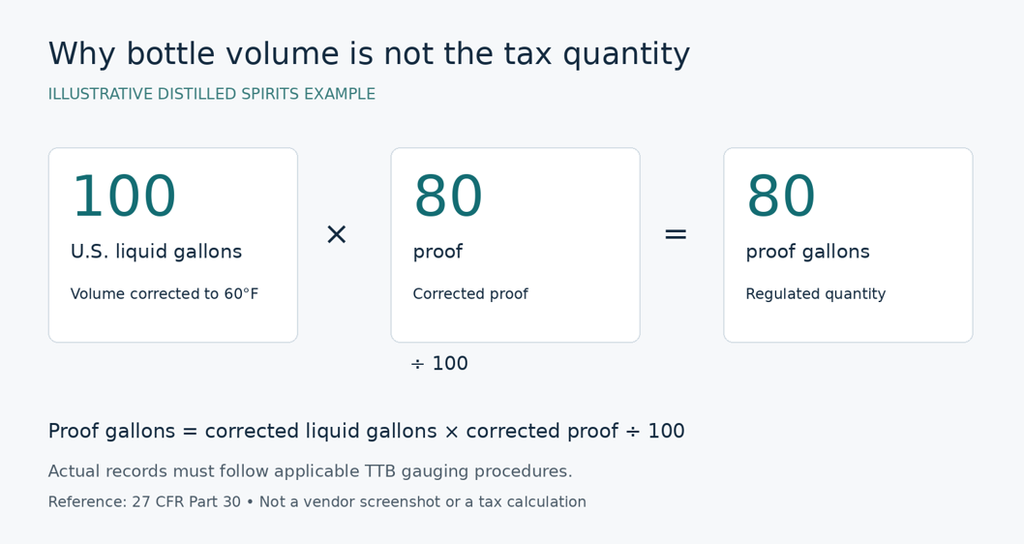
Compliance software for alcohol producers manages regulated quantities and records. For a distillery, a central measure is the proof gallon: the equivalent of one U.S. gallon of spirits at 100 proof, referenced to 60°F under the TTB gauging rules. Depending on its features, the software can track spirits through production, storage and processing, record transfers and losses, support tax determination, and prepare the applicable TTB operational reports: Form 5110.40 for production, 5110.11 for storage and 5110.28 for processing. The excise tax return, Form 5000.24, is separate: its filing schedule may be semimonthly, quarterly or annual, depending on eligibility. For wineries and breweries the quantities, forms and filing schedules differ.
This is a practical example of the distinction between vertical and horizontal SaaS: specialized workflows matter more than the category label.
The general federal excise tax rate on distilled spirits is $13.50 per proof gallon. Eligible domestic producers may use $2.70 on the first 100,000 proof gallons removed during the calendar year and $13.34 on the next 22.13 million. These TTB tax rates depend on eligibility, including qualifying distilling or processing; bottling alone does not qualify. Tax determination generally relates to taxable removal, rather than the invoice date. Transfers in bond and other authorized withdrawals require different treatment under TTB guidance. Required Part 19 records must generally be retained for at least three years from the record date or last required entry, whichever is later; TTB may require longer record retention. Three consequences follow. First, regulated quantities need traceable measurements and calculations, rather than unexplained figures typed into a field. Temperature affects gauging, and aging can change both volume and proof. Second, movements between accounts need matching records, with quantities and tax status reconciled. Third, records should show when entries were made and how subsequent corrections were handled. An ERP can store these details, but a general-purpose configuration may need industry-specific functionality to handle them reliably
Compare demonstrated capabilities, not category promises. An industry-specific ERP may cover both columns.
| Criterion | General ERP | Specialized compliance software |
| Units and gauging | Configured units and conversions; spirits features may need an extension | Verify corrected proof, proof gallons and saved gauging inputs |
| Regulatory accounts | Inventory locations are not automatically regulatory accounts | Verify production, storage, processing and tax-status handling |
| Transfers and losses | Inventory movements and adjustments | Verify matching transfers, loss causes and tax treatment |
| Tax determination | Depends on industry configuration | Verify eligibility, removals and shared reduced-rate limits |
| Audit trail | Capabilities vary by product and settings | Verify original values, corrections, users and timestamps |
| Operational reports | May require exports or an industry module | Verify required forms and reconciliation before filing |
| Other jurisdictions | Depends on modules and configuration | Confirm each state or country; do not assume coverage |
| Financial operations | Core strength in a suitably configured ERP | May be limited; check accounting integration |
| Implementation | Scope depends on modules, migration and integrations | Scope depends on records, onboarding and integrations |
Nobody should run a growing producer’s payables out of a compliance tool. The ERP is the right place for the general ledger, purchasing, sales orders, customer records, cost accounting and the reports a bank or an investor wants to see. If you sell into distribution in several states, the ERP’s order management and invoicing will carry far more of your daily workload than the compliance system ever will. Multi-entity consolidation, budgeting, and integration with payroll and e-commerce are ERP territory and should stay there.
The ERP also tends to offer a broader support ecosystem. Compliance software for alcohol is a niche, and the vendor may also be the support desk. Ask who handles implementation, regulatory updates and urgent filing questions.
It wins where specialized regulatory workflows are the priority, provided the product actually supports them. Proof-gallon calculations should be consistent and traceable. The account structure should help prevent misclassification. Losses should carry their cause and appropriate tax treatment. Applicable reports should reconcile to the underlying records. An audit trail should preserve original entries and subsequent corrections, with user identities and timestamps; a server timestamp alone does not establish compliance.
It can also win on setup effort. A distillery with one still may not need an ERP-sized implementation. But setup time depends on opening balances, historical records, training and integrations. Ask for a realistic onboarding plan and the limits of any free tier rather than assuming the compliance layer will be ready in an afternoon.
Producers compare license fees, conclude the ERP is the bigger investment, and assume it is therefore the more complete one. The real cost of an ERP-only route can include hours spent rebuilding federal reports from exports, and the exposure created when those reports drift from the source records. If reduced-rate eligibility is not supported, additional tax may be due. The amount depends on the applicable rate, affected removals and circumstances; it is not automatically the difference between $2.70 and $13.50 on a full year of production. Include reconciliation work, migration, training and ongoing support in the comparison.
The real cost of the compliance-only route is the opposite problem: you end up keeping the books somewhere else anyway, usually in a small-business accounting package, and reconciling the two by hand.
One workable arrangement is to make the compliance system the system of record for regulated quantities and reporting, and the ERP the system of record for financial and commercial transactions, with a clear line between them.
Regulated quantities, accounts, tax status, losses, removals and operational reports belong in the designated compliance record. At month-end, a reviewed summary can support accounting entries for excise tax, inventory movements and losses. Proof gallons are quantities, not monetary journal entries: the accountant still needs the correct valuation and account mapping. The ERP can receive quantities and references without independently recalculating them.
This can be simpler than maintaining competing calculations in two places. For a small operation, a reviewed export may be enough; a growing producer may need more frequent inventory updates or an integration. Decide who owns corrections, how duplicate entries are prevented, and how the systems reconcile. SaaSComparely’s guide to SaaS integrations explains the main connection options. A single industry-specific platform is also viable if it demonstrates both financial and regulatory workflows.
The new distillery with one still and no distribution. Compliance capability first, plus whatever accounting package the bookkeeper already uses. There may be no ERP-sized problem here yet. Required production reports are monthly, including zero-activity months when production operations are on the permit and registration, as explained in the TTB Form 5110.40 instructions. Spend the ERP budget on barrels if the simpler setup covers the work.
The growing producer selling through distributors in several states. Both capabilities matter. The ERP earns its keep on orders and receivables; the compliance system supports reconciled federal reporting. Confirm state-by-state coverage separately. Make sure the compliance tool exports data the ERP can use and identify which system owns regulated calculations.
The group with several permits, or a consultant with several clients. Look for separate records and reports for each plant, with consolidated visibility where appropriate. Do not assume every permit gets its own reduced-rate allowance. Controlled-group and single-taxpayer rules can require aggregation across entities or production arrangements. The system must keep plant records distinct while applying the relevant shared limits.
A general ERP and specialized compliance software serve different needs. The ERP keeps the books; the compliance system supports regulated records and reporting. Producers who buy a general ERP and expect it to produce a 5110.40 without checking its capabilities can end up with a spreadsheet workaround. Producers who buy compliance software and expect it to run payables may need a second system anyway. The ERP vs compliance software decision comes down to capabilities, reliable records and a clear boundary between systems. Decide that boundary before you sign anything.
Ben Terebelo is the master distiller at Terebelo Distillery in New York and the founder of TTBMath.com, a compliance and proofing platform for craft alcohol producers. His distillery and work have been featured in Forbes.