
Open Source vs SaaS, When Should You Choose Open Source Software?
- September 25, 2026
- 0
Open source and SaaS answer two different questions, and treating them as opposite ends of the same scale is where most of the confusion starts. Open source is

Open source and SaaS answer two different questions, and treating them as opposite ends of the same scale is where most of the confusion starts. Open source is
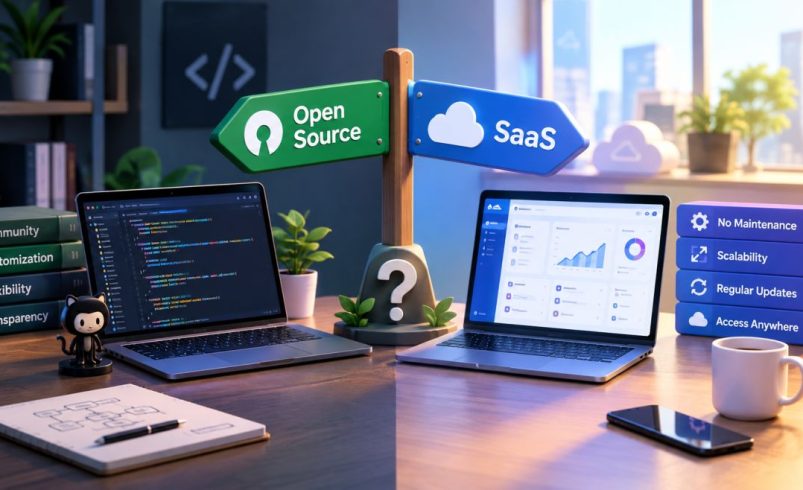
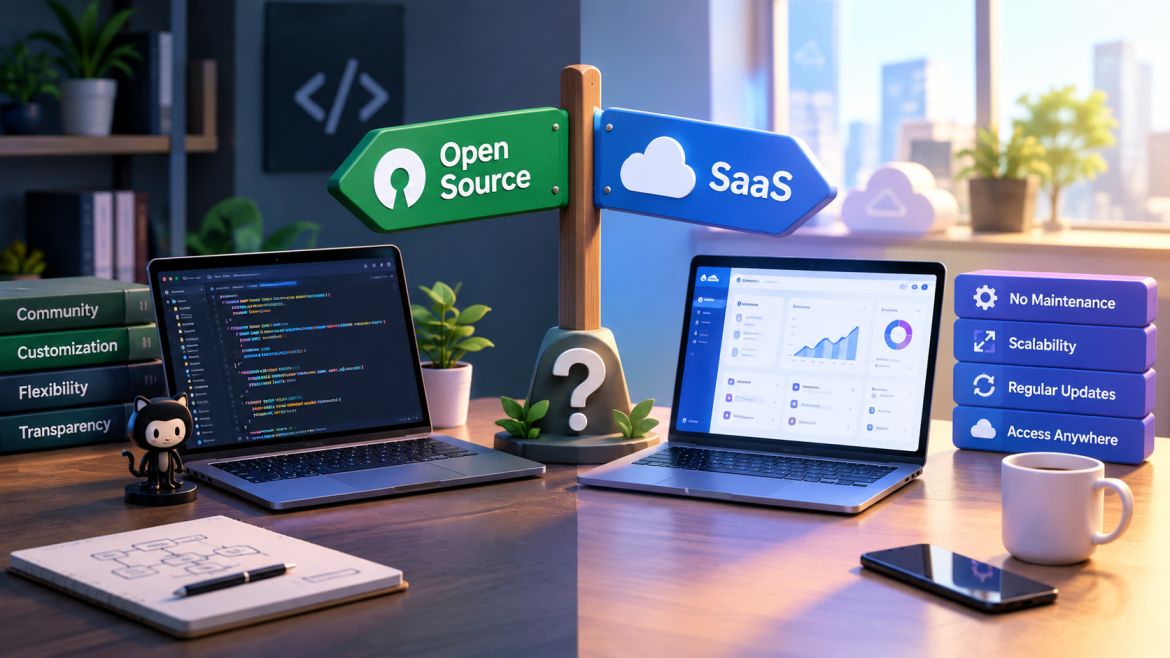
Open source and SaaS answer two different questions, and treating them as opposite ends of the same scale is where most of the confusion starts. Open source is about who can see, modify, and redistribute the underlying code. SaaS is about who runs the servers and handles the maintenance. A product can be both at once, and increasingly, the most useful tools on the market are exactly that.
That distinction changes the real question a buyer should be asking. It is rarely “open source or SaaS.” It is closer to “who do we want responsible for this system two years from now, and what are we willing to trade to get there.”
Open source software ships its source code publicly under a license that permits inspection, modification, and in most cases redistribution. The Open Source Initiative’s Open Source Definition sets the ten criteria a license has to meet to earn the label, covering everything from free redistribution to a ban on discriminating against specific fields of use.
Licenses within that category still differ sharply in what they require back from you. Permissive licenses like MIT place almost no conditions on how you use the code. Copyleft licenses like AGPL, the license Plane’s community edition ships under, require that any modifications to the source remain open under the same terms if you distribute them. That single clause is often the deciding factor for a company weighing whether to build on top of an open source project commercially.
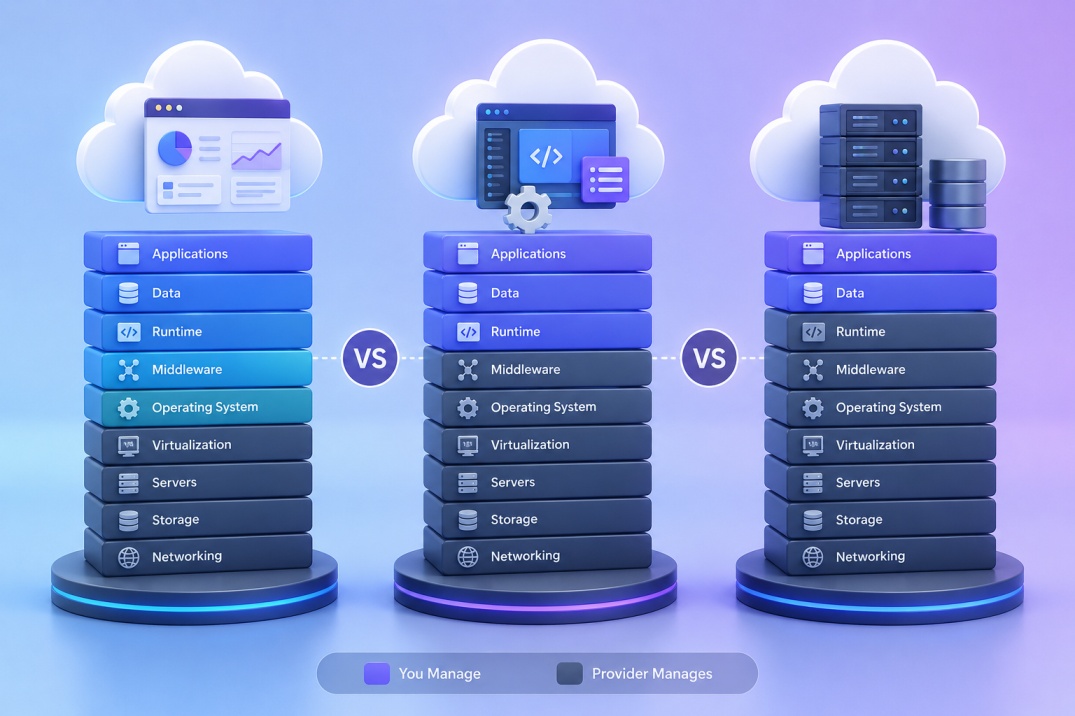
Software as a service means the vendor owns the infrastructure, the deployment, the patching, and usually the uptime guarantee. You are buying access, typically through a subscription, and the tradeoff for giving up control over the code is that someone else absorbs the operational burden of running it.
This is where SaaS earns its appeal for smaller teams. There is no server to provision, no security patch to schedule at 2 a.m., and no version upgrade that breaks a customization nobody remembers writing. The vendor’s roadmap becomes your roadmap, for better and for worse.
Some of the most useful products in 2026 refuse to sit cleanly in either category. PostHog bundles product analytics, session replay, feature flags, and experimentation into one open source platform, and it offers both a usage-based cloud plan and a fully self-hosted option, so the same codebase can be run either way depending on what a team needs. For a closer look at how that pricing model compares with closed alternatives,our comparison of PostHog against Amplitude and Mixpanel breaks down where the open source option actually saves money and where it does not.
Plane follows a similar pattern in project management. Its community edition is free and self-hostable under AGPL-3.0, its cloud version handles hosting for teams that would rather not run their own infrastructure and a growing set of third-party providers now offer managed hosting of the open source edition itself, running the software on infrastructure they control while the team keeps data ownership. One example is a managed hosting arrangement that pairs the open source platform with dedicated, GDPR-compliant infrastructurewhich sits somewhere between pure self-hosting and pure SaaS. This middle tier is worth knowing about, because it often solves the actual problem, wanting control without wanting to run a server, better than either pure model does on its own.
The license fee on open source software is genuinely zero, but that number rarely represents what it costs to run in production. Self-hosting still requires servers, backups, monitoring, security patching, and someone on staff who understands the stack well enough to fix it when it breaks at an inconvenient hour.
Independent cost research on self-hosted analytics infrastructure puts the hidden cost of running an open source platform yourself at roughly twelve thousand to fifty-four thousand dollars a year once server capacity and engineering time are included. That figure will vary by workload and team, but the pattern holds across most self-hosted categories. Free software still needs someone to run it, and that someone’s time is never actually free.
SaaS pricing is more predictable, but predictable is not the same as cheap or risk-free. Usage-based and per-seat models both tend to climb as a team grows, sometimes faster than a company’s headcount does. Annual renewals routinely carry a price increase that was not part of the original negotiation.
Vendor dependence is the less visible cost. Once a workflow, integration, and years of historical data live inside a proprietary SaaS product, switching away from it becomes expensive even if a cheaper or better tool appears later. That dependence is the tradeoff a company is accepting in exchange for not having to run anything itself.
Source code access is the clearest advantage open source holds. A team with the right engineering capacity can change how the software behaves at a level no SaaS vendor’s settings page would ever expose, from custom data models to entirely new modules.
That advantage only pays off if the team can actually use it. Source access sitting unused because nobody has time to touch the codebase is not really an advantage, it is a maintenance liability waiting for someone to inherit it.
Self-hosting gives a company full control over where data lives, which matters directly for data residency rules and industries with strict compliance requirements. Nothing leaves infrastructure the company controls unless it is explicitly configured to.
That control comes with responsibility attached. A self-hosted deployment is only as secure as the team running it, and a missed patch on a self-hosted instance is a self-inflicted vulnerability. Established SaaS vendors, by contrast, typically invest in dedicated security teams and formal certifications that most individual companies could not replicate on their own, though that security is only as good as the vendor’s own track record.
This is usually where the decision actually gets made. Self-hosted open source software needs someone internally who understands deployment, scaling, and troubleshooting well enough to keep it running without the vendor on the other end of a support ticket.
A small team without dedicated engineering capacity is usually better served by SaaS, or by a managed hosting arrangement for an open source product, than by self-hosting outright. A team with in-house infrastructure expertise and a genuine need for customization or data control is the profile that tends to get real value from running the open source path themselves.
| Factor | Tends to favor SaaS | Tends to favor open source |
|---|---|---|
| Team size and technical staff | Small team, limited engineering time | In-house infrastructure or DevOps capability |
| Customization needs | Standard workflows, vendor features are enough | Needs deep changes to core functionality |
| Data residency or compliance | Vendor already certified for the requirement | Requirement demands full control over hosting location |
| Budget shape | Predictable subscription preferred | Willing to trade cash for engineering time |
| Speed to deploy | Needs to be running this week | Has time to plan and maintain infrastructure |
| Long-term flexibility | Comfortable with vendor’s roadmap | Wants freedom to fork or modify long term |
Open source is not automatically cheaper, and SaaS is not automatically the safer default. The honest framework is closer to a spectrum than a binary. Pure SaaS suits teams that want the operational burden gone entirely. Pure self-hosted open source suits teams with the engineering capacity to treat that burden as an investment rather than a cost. Managed open source hosting, the option most buyers overlook, often fits the teams stuck in between, wanting the control and licensing terms of open source without taking on the infrastructure themselves. The right answer depends on what a team is actually equipped to operate, not on which model sounds more virtuous on paper.