HighLevel vs HubSpot for Agencies: Which CRM-Marketing Hybrid Wins?
June 16, 2026
0
Two tools. Two philosophies. One genuinely complicated decision for agencies trying to run leaner operations in 2026. HubSpot built its category position by being the CRM and marketing
Two tools. Two philosophies. One genuinely complicated decision for agencies trying to run leaner operations in 2026.
HubSpot built its category position by being the CRM and marketing platform that growing teams could actually figure out. It succeeded. It is now one of the most widely adopted marketing software ecosystems in the world, with a training library, certification program, and partner network that have created an entire professional ecosystem around its methodology.
HighLevel built something different. Not a platform for businesses to manage their own marketing, but a platform for agencies to manage their clients’ marketing and deliver it as a white-label product. The intent was never to replace HubSpot broadly. It was to replace the 12 to 15 tools a typical digital agency was duct-taping together to deliver services.
Understanding which one wins for your agency depends less on feature checklists and more on what your business model actually requires.
Positioning: Built for Different Operators
HubSpot is a platform businesses use to manage their own marketing, sales, and service operations. Agencies can use it directly for clients under the Solutions Partner Program, which provides access to a client management dashboard, seat discounts, and partner certifications. But the product was not designed with the agency delivery model as its primary use case.
HighLevel was. Sub-accounts, SaaS Mode, white-label mobile apps, automated client provisioning, rebilling infrastructure, and snapshot templates for replicating agency setups across new clients are all native features. The product architecture assumes that the person running it is not the same person as the client benefiting from it.
This distinction shapes every comparison that follows. Where HubSpot does something better, it is usually in depth within its own ecosystem. Where HighLevel does something better, it is usually in how efficiently an agency can deliver that capability across multiple clients.
CRM and Lead Management
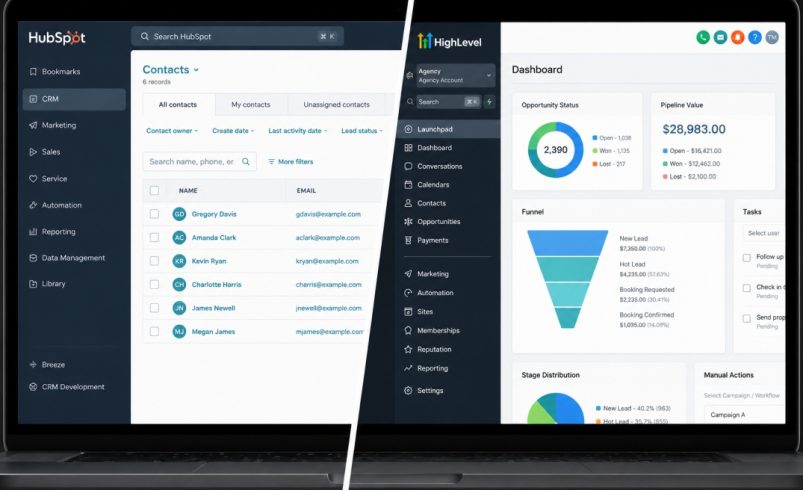
HubSpot’s CRM is genuinely strong. Contact records, pipeline management, deal stages, and company association all work with a level of polish and depth that took years to build. The integration with HubSpot’s marketing tools is tight: lead source attribution, lifecycle stage automation, and revenue reporting flow naturally from one module to another. For agencies managing a client with a complex B2B sales cycle and an existing HubSpot investment, working within that ecosystem makes sense.
HighLevel’s CRM is functional and improving but still secondary to its automation and communication strengths. Pipeline management, contact tagging, and lead routing are solid. The edge over HubSpot for agency delivery is in communication integration: HighLevel natively connects CRM records to two-way SMS, call tracking, voicemail drops, and review requests in a way that HubSpot requires multiple integrations to replicate.
For agencies running lead follow-up automation for local service businesses, HighLevel’s unified communication layer delivers faster response workflows than HubSpot’s more modular approach.
Marketing Automation
This is where the comparison gets more nuanced. HubSpot’s workflow automation is deep and well-documented. Conditional branching, goal-based enrollment, re-enrollment logic, and native integration with HubSpot’s contact and deal data give it an edge for complex marketing programs. The visual workflow builder is one of the clearest in the industry, and HubSpot’s documentation means less reliance on platform expertise to build sophisticated sequences.
HighLevel’s automation builder covers the same core capabilities: trigger-based workflows, conditional logic, time delays, and multi-channel sequences. What it adds that HubSpot cannot easily replicate natively is SMS and voice automation alongside email in the same workflow. An agency running a five-touch lead nurture sequence for a contractor client that includes email, SMS, and a voicemail drop can build that entirely in HighLevel. In HubSpot, the same sequence requires third-party SMS and voice integrations.
For marketing-heavy clients with sophisticated email programs, HubSpot’s automation engine is more capable. For agencies running high-touch local service lead management, HighLevel’s multi-channel native stack wins.
White-Labeling and Agency Infrastructure
HubSpot offers no white-label capabilities. Clients using HubSpot-delivered services interact with HubSpot’s interface, receive HubSpot-branded emails, and can access HubSpot’s knowledge base. For agencies building a proprietary software brand, HubSpot is simply not a viable option.
HighLevel’s white-label infrastructure is the platform’s defining feature. At the $297/month Unlimited tier, agencies replace all HighLevel branding with their own across the client-facing platform. At $497/month for Agency Pro, white-label extends to a mobile app, automated sub-account creation, and client-facing billing under the agency’s Stripe account. Clients interact with a software product that is, to them, entirely the agency’s own creation.
For agencies where building a proprietary SaaS product or a branded client portal is a strategic priority, this is a non-negotiable advantage for HighLevel. There is no HubSpot workaround.
Reporting
HubSpot’s reporting suite is one of its strongest assets, particularly on higher-tier plans. Custom dashboards, multi-touch attribution, revenue reporting, and campaign analytics give clients and agencies a credible performance view across the full marketing and sales funnel. HubSpot’s data model, which ties contacts, deals, and campaigns together natively, produces attribution reporting that most third-party stitching approaches cannot replicate.
HighLevel’s native reporting is serviceable but not HubSpot’s equal for complex attribution work. Pipeline reporting, call tracking dashboards, and automation performance metrics are solid. Where agencies need cross-channel attribution or board-level revenue reporting for sophisticated clients, pairing HighLevel with a dedicated reporting layer like AgencyAnalytics, as covered in SaaSComparely’s comparison of the best white-label SaaS tools, closes most of the gap.
Pricing Comparison
HubSpot’s pricing model is one of the most criticized elements of the platform. The free CRM creates an accessible entry point, but meaningful marketing and sales functionality sits behind Starter, Professional, and Enterprise tiers that scale with contact counts and feature access. A properly equipped HubSpot setup for a single client requiring Marketing Professional and Sales Professional access regularly runs $1,000 to $2,000 per month or more.
HighLevel’s pricing is flat by sub-account count. The $297/month Unlimited plan covers unlimited client accounts with the same base feature set. The total cost of serving 20 clients on HighLevel is the same $297 platform fee plus usage charges, regardless of how many contacts exist across those accounts. Usage costs for SMS, voice, and AI features are rebillable to clients through SaaS Mode, which shifts the marginal cost to the client relationship rather than the agency’s platform budget.
Factor
HighLevel (Agency Pro)
HubSpot (Pro/Enterprise)
Platform Price
$497/mo flat (unlimited clients)
$1,000-$3,000+/mo per client setup
White-Label
Full (logo, domain, mobile app)
None
CRM Depth
Functional; improving
Deep; native attribution
Email Automation
Strong, multi-channel native
Deep; best-in-class for email
SMS/Voice Native
Yes, built-in
No (requires integrations)
Sub-Accounts
Unlimited at $297+/mo
No native sub-account model
Reporting
Functional; gaps in attribution
Strong; native multi-touch
Learning Curve
Steeper; more moving parts
Gentler; strong documentation
Integrations
HubSpot integrates with over 1,500 apps through its marketplace, including Salesforce, Slack, Google Workspace, Zoom, and most major advertising platforms. The breadth reflects HubSpot’s position as a hub platform: it assumes agencies and businesses are running other tools and connects to them.
HighLevel integrates with major platforms through Zapier, native connections, and direct API access. Coverage is narrower than HubSpot’s marketplace but typically sufficient for agency operations. Where HighLevel’s integration story is weaker is in deep B2B data connectivity and enterprise system integration, which matters less for SMB-focused agency clients than for enterprise sales operations.
Ease of Use and Learning Curve
HubSpot has invested heavily in onboarding, documentation, and the HubSpot Academy certification ecosystem. For agencies hiring team members with general marketing backgrounds, HubSpot’s learning curve is manageable. The interface is intentionally approachable.
HighLevel is more complex to set up and operate. The platform’s power comes with configuration overhead: snapshots need to be built, sub-accounts need to be structured, automation workflows need to be mapped correctly for each client type. Agencies that have invested in HighLevel expertise or that follow established agency frameworks tend to get strong results. Agencies expecting a plug-and-play tool often struggle in the first 60 days.
Which Agencies Should Choose HighLevel
HighLevel is the stronger choice for agencies whose primary value is marketing execution and client management at scale. Specifically: agencies serving five or more clients on recurring retainers, agencies building white-label software products or SaaS revenue streams, agencies delivering high-touch lead management for local service businesses where SMS and voice automation are core, and agencies looking to reduce their total tool stack cost by consolidating CRM, automation, and communication into one platform.
Which Agencies Should Choose HubSpot
HubSpot is the stronger choice for agencies managing clients with existing HubSpot investments, clients running complex B2B sales cycles requiring deep CRM and attribution, or clients in industries where the HubSpot ecosystem is standard. It also suits agencies whose core differentiator is marketing strategy and reporting quality rather than execution speed and white-label delivery.
Frequently Asked Questions
Can HighLevel replace HubSpot entirely for a mid-sized agency?
For most marketing and lead generation-focused agencies, yes. HighLevel’s CRM, automation, and communication stack cover the majority of what HubSpot’s Starter and Professional tiers deliver. Gaps remain in complex multi-touch attribution and deep B2B CRM functionality. Agencies working with enterprise clients or B2B clients with long sales cycles may need HubSpot’s depth for those accounts specifically.
Does HubSpot have anything like HighLevel’s SaaS Mode?
No. HubSpot’s partner program provides pricing benefits and a partner dashboard, but there is no mechanism for agencies to white-label the product and resell it as their own under automated billing. SaaS Mode is a HighLevel-specific capability.
Is HighLevel cheaper than HubSpot for a 10-client agency?
Almost always, yes. A 10-client agency on HighLevel Unlimited pays $297/month regardless of client contact counts. Equipping 10 HubSpot client accounts with Marketing Professional functionality could exceed $10,000 per month in combined licensing depending on contact volume. Even accounting for HighLevel’s usage fees, the economics strongly favor HighLevel for agencies managing multiple client accounts.
What happens to client data if I leave HighLevel?
Data export tools allow you to pull contact records, conversation history, and workflow data before canceling. Importantly, HighLevel terminates access immediately upon cancellation confirmation, so exporting all client data before canceling is critical. HubSpot also offers data export tools, but contact records stay accessible for a grace period after cancellation.
Final Verdict
For agencies building a scalable, multi-client service business in 2026, HighLevel wins this comparison cleanly on pricing, white-label capability, and multi-channel automation for the client types most agencies serve. The learning curve is real, and the initial setup investment is higher than HubSpot’s. But agencies that commit to the platform typically recoup that investment within 90 days.
HubSpot wins when the client relationship requires it: B2B clients with established HubSpot investments, complex attribution requirements, or enterprise sales cycles where HubSpot’s CRM depth is genuinely necessary.
The agencies making the strongest platform decisions in 2026 are not asking which tool is better in isolation. They are asking which tool their client base actually needs, and then building their operations around the honest answer to that question.