Best SaaS Marketing Tools: Demand Generation to Performance Tracking
March 3, 2026
0
Demand generation and performance tracking are two sides of the same coin, and yet most marketing teams treat them as entirely separate problems. You invest in tools that
Demand generation and performance tracking are two sides of the same coin, and yet most marketing teams treat them as entirely separate problems. You invest in tools that create demand, ads, content, SEO, outbound sequences, and then you invest in separate tools to measure what happened. When those two sides don’t talk to each other well, you end up with a lot of activity and not much clarity about what’s actually driving results.
This guide looks at the SaaS tools that marketing teams use across the full arc from demand creation to performance measurement, and how to think about building a stack where those two functions actually connect.
Understanding the Demand Generation Stack
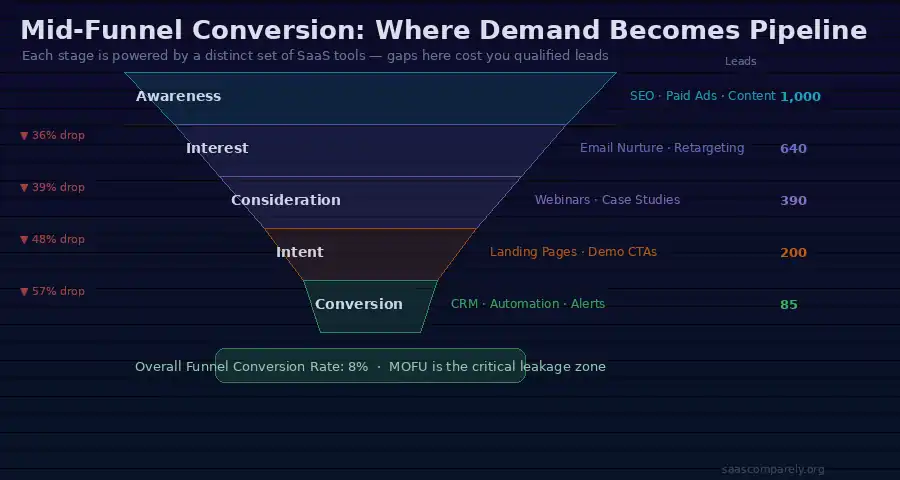
Demand generation is a broad umbrella. It covers everything from top-of-funnel awareness activities, content marketing, SEO, social advertising, to mid-funnel conversion work like email nurture, retargeting, and webinars. Different tools serve different parts of this funnel, and the right mix depends on which channels your buyers actually use.
B2B marketing, in particular, has a specific demand gen profile. Buying cycles are long, decision-making is committee-based, and the path from first touch to closed deal rarely follows a tidy linear sequence. The tools you choose need to account for this complexity, especially in how they handle attribution and multi-touch tracking.
Top-of-Funnel Demand Creation
At the top of the funnel, your goal is getting in front of buyers who don’t yet know they need what you offer, or who are just beginning to research their options. The tools that support this work include SEO platforms, content distribution tools, paid advertising management, and social publishing software.
SEO tooling is worth particular attention because it sits at the intersection of demand creation and performance tracking. A good SEO platform tells you which keywords are driving traffic, which pages are converting, and where your content gaps are — information that directly informs campaign strategy. For teams investing heavily in content, an SEO platform isn’t optional.
Paid advertising management platforms have also matured significantly. Modern ad management tools allow for audience segmentation, creative testing, bid strategy automation, and cross-platform budget management from a single interface. The challenge is that each major ad platform also has its own native tools, and many teams end up managing campaigns in multiple places. A centralized ad management layer reduces that overhead.
Mid-Funnel Conversion Tools
Once you’ve generated awareness and captured intent signals — form fills, content downloads, demo requests — the mid-funnel is where you convert that interest into qualified pipeline. The tools here are email platforms, marketing automation systems, CRM integrations, and landing page builders.
Landing page tools deserve more attention than they typically get. A high-converting landing page can dramatically improve the ROI of every demand gen channel feeding into it. The ability to test variations quickly — headlines, CTAs, form lengths — directly impacts your cost per lead. Many teams use the landing page functionality built into their marketing automation platform, but dedicated landing page tools often offer more flexibility and faster iteration.
For teams whose marketing efforts connect directly to a customer onboarding flow, it’s worth understanding how the handoff between demand gen and product adoption works. The guide on Best SaaS Onboarding explores the tools that take over once a user converts — relevant context if your marketing and onboarding functions share responsibility for early activation.
Performance Tracking: Going Beyond Last-Click
Performance tracking is where a lot of marketing teams have a data problem disguised as a tools problem. The actual issue is that last-click attribution — the default model in most ad platforms and basic analytics tools — systematically distorts which channels are generating value.
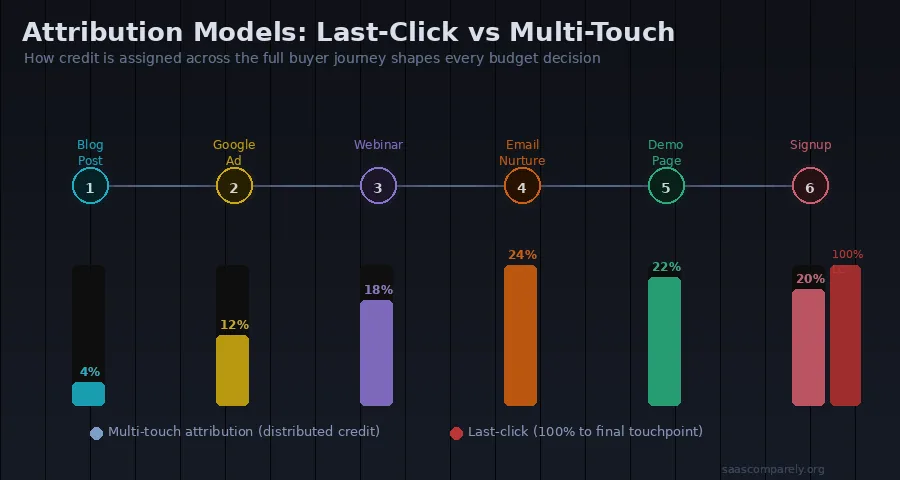
Last-click gives 100% of the credit for a conversion to the last touchpoint before the action. In a world where buyers interact with your brand across email, social, search, and direct before finally converting, this creates a wildly inaccurate picture. Channels that do top-of-funnel awareness work get no credit. Channels that are good at capturing existing intent look like they’re generating it.
Moving beyond last-click attribution requires tools that can track multi-touch journeys and apply more sophisticated attribution models — linear, time-decay, position-based, or data-driven. Not every team is ready for this level of sophistication, but for teams spending significant budget across multiple channels, the investment in better attribution tooling pays off quickly in clearer allocation decisions.
Web Analytics
Web analytics is the foundation of marketing performance tracking. While the dominant tools in this space have been around for a long time, the category is evolving — particularly around privacy compliance, cookie deprecation, and the shift toward first-party data.
Modern web analytics tools range from straightforward traffic and conversion tracking to more sophisticated behavioral analytics that can show you how users move through your site before converting. The latter is particularly useful for optimizing landing pages and conversion flows, where understanding user behavior — not just aggregate metrics — leads to better decisions.
One underused feature in many web analytics platforms is the integration with CRM data. When you can connect website behavior to known contacts in your CRM, you get visibility into how specific companies or segments are engaging with your content — information that’s invaluable for account-based marketing strategies.
Marketing Analytics Dashboards and Reporting
Most marketing teams pull data from a dozen different sources — paid platforms, email tools, organic search, social channels, CRM. The reporting problem is real: stitching together screenshots and exports into a coherent narrative every week is a significant time drain.
Marketing analytics dashboards solve this by pulling data from multiple sources into a single view with consistent metrics and visual reporting. The sophistication ranges from relatively simple dashboard tools with pre-built connectors to full business intelligence platforms that allow custom data modeling.
For most marketing teams, the practical choice sits somewhere in the middle: a dashboard tool that connects to the five to ten sources you actually care about, with enough flexibility to build the views your team needs without requiring a data analyst to maintain it.
The Integration Problem in Marketing SaaS
Marketing tools have a well-earned reputation for poor interoperability. Every vendor claims to integrate with everything, but in practice, the quality of those integrations varies enormously. Bi-directional CRM sync, for example, is listed as a feature on most marketing automation platforms, but the actual sync behavior — which fields update, how often, in which direction — is often limited and fragile.
Before committing to any marketing platform, test the integrations with your actual existing stack. Don’t rely on the integration documentation alone — actually build a test workflow and see if data flows the way you need it to. Discovery of integration gaps after you’ve already migrated is expensive and disruptive.
B2B vs B2C Marketing Tool Considerations
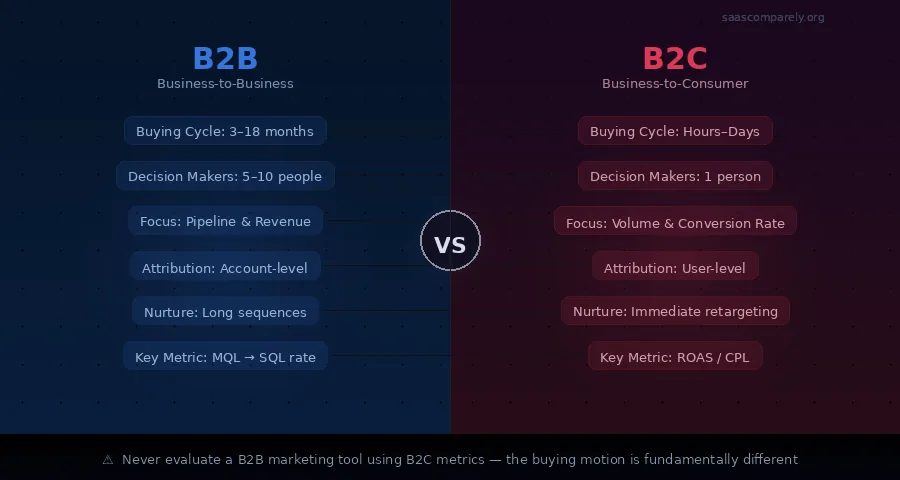
The demand gen and performance tracking landscape looks meaningfully different depending on whether you’re in B2B or B2C. B2C teams typically deal with higher volumes, shorter buying cycles, and strong e-commerce integration requirements. B2B teams deal with longer cycles, multiple stakeholders, and the need to connect marketing activity to pipeline and closed revenue.
B2B marketing tools need to handle account-level tracking (not just individual user-level tracking), integrate deeply with sales CRM systems, and support longer nurture sequences. B2C tools are often optimized for conversion velocity, personalization at scale, and direct revenue attribution.
The mistake is buying tools built for the wrong motion. A B2B team using tools optimized for B2C volume and conversion speed will find that the reporting doesn’t match how their business actually works. Clarify your buying motion before evaluating any marketing platform.
Building Toward a Connected Marketing Stack
The most effective marketing stacks aren’t necessarily the ones with the most sophisticated individual tools — they’re the ones where data flows cleanly from demand creation through to revenue, with visibility at every step. That means fewer tools, tighter integrations, and a clear owner for the stack’s architecture.
A practical way to evaluate your current stack: trace a buyer’s journey from first touch to closed deal and see whether you can reconstruct it from the data you have. If you can’t — if there are gaps where touchpoints go untracked or attribution data disappears — those gaps are where your tooling investments should go next.
Demand generation without measurement is spending without learning. Performance tracking without demand gen is analysis without action. The goal is a stack where both sides of that equation are connected and inform each other in something close to real time.